

ISVA Participation
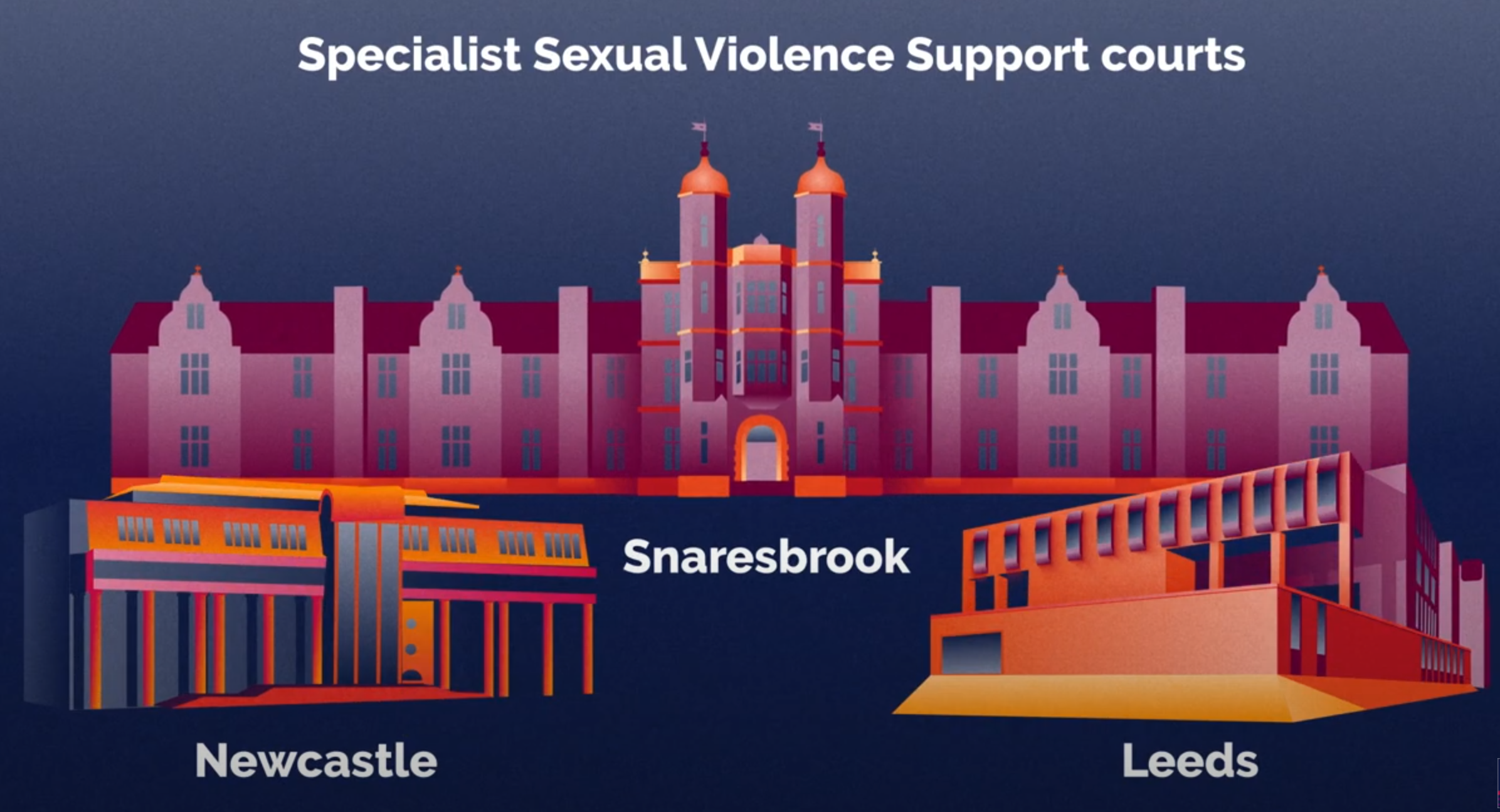
During Phase II of the project, we spoke to ISVAs working in Leeds, Newcastle and Snaresbrook, to learn more about their experiences of supporting victims and survivors at SSVS courts.
This webpage sets out some of the key information which was provided to ISVAs to help them decide whether to take part in the research.
Though we are no longer recruiting ISVAs to take part in this case study, we still welcome any questions or queries ISVAs may have about the research, please email natalie.kyneswood@csls.ox.ac.uk or use the ISVA contact form.
ISVAs' feedback will be used to:
- write a report about the use of specialist courts and trauma-informed approaches in sexual offence cases;
- write a briefing for survivors;
- help government, the courts, lawyers and police understand court practice from ISVAs' perspectives.
News about further outputs will be available on the website shortly.
Q&As about taking part...
Care in the Courtroom is an independent, five-year, research project investigating the introduction of trauma-informed, specialist sexual offence courts in England and Scotland and the impact of these courts on victims’ and survivors’ sense of justice and wellbeing.
As part of the project, we are carrying out a one-year investigation of ‘enhanced support measures’ at Specialist Sexual Violence Support pilot courts in Leeds, Newcastle and Snaresbrook. We are hoping that this will include speaking to victims and survivors, ISVAs, and barristers and observing rape and sexual assault cases at SSVS courts.
There is a separate webpage for Victim and Survivor Participation and Observation of Rape and Sexual Assault Cases at SSVS courts.
The views are ISVAs are incredibly important to understanding the links between the court and the role of wider, wrap-around services. ISVAs provide unique insights and perspectives through working closely with and attending court with victims and survivors. However, there is very little information about ISVAs' and victims' and survivors' experiences of recent procedural reforms, including section 28. It is hoped that at least 30 ISVAs will take part in the study.
- Dr Natalie Kyneswood is organising the project. She is a researcher at the Centre for Socio-Legal Studies, Faculty of Law, University of Oxford. Natalie is hoping to speak to ISVAs who cover Leeds or Newcastle Crown Courts.
- Dr Alma Ionescu is also working on the project. She is a researcher at the Centre for Socio-Legal Studies. Alma is hoping to speak to ISVAs who cover Snaresbrook Crown Court.
- Rape Crisis England and Wales and the Ministry of Justice are also supporting us on the project.
- The project is funded by Wellcome Trust and has received ethics approval from the University of Oxford’s Social Sciences and Humanities Interdivisional Research Ethics Committee Ref: 1847247
- You will be interviewed either in person or online, at a time convenient for you;
- You will be asked to complete a consent form to say that you agree to take part in the research;
- The interview should normally last approximately 45 minutes;
- With your consent, we would like to record the conversation to make sure we produce an accurate written copy of what you say. The recording will be deleted as soon as the interview is written up.
Aside from giving up your time, which we greatly appreciate, there are no risks or disadvantages. Though there is no immediate benefit in participating in the research, ISVA’s viewpoints will undoubtedly produce a more nuanced, balanced understanding of specialist court practices introduced to date. They will also contribute to policy and academic outputs, including:
- A briefing for victims and survivors;
- A report for government and stakeholders on SSVS courts;
- A journal article tracing the development of specialist sexual offence courts in the UK;
- A book comparing specialist courts in sexual offence cases.
Travel costs and additional expenses, such as childcare, are available to help ISVAs cover costs of attending interviews in-person.
You will be asked your opinion of trauma-informed court practice, specialist court procedures in sexual offence cases, and the ‘enhanced support measures’ provided at the SSVS court where you work. The information you provide will help us answer our research questions, including:
- How is trauma-informed care understood and assimilated in sexual offence cases?
- Are 'specialist' courts/courtrooms necessary to achieving trauma-informed practice?
- Do trauma-informed approaches or specialist courts help generate shifts in the way that victims and survivors are treated and questioned, and participate in court proceedings?
- What tensions arise when incorporating trauma-informed practices and can these be reconciled?
We will also ask you to complete an Equality and Diversity Monitoring Form, but this is entirely voluntary.
- Your consent form and interview transcript will be stored electronically on University password protected computer servers and kept securely for at least 3 years after publication of the work.
- With your permission, we would like to deposit a copy of your anonymised interview transcript in the Oxford University Research Archive and UK Data Archive so other researchers may also refer to it.
- We will use your interview data to write a publicly available report, an academic article, and a book about specialist courts in sexual offence cases.
- The aim is that these outputs will be used to inform future law and policy on trauma-informed, specialist court approaches. With your permission, we would like to directly quote from the interview in research outputs without naming or identifying you.