

Aashish Pant
Could you tell us about the topic of your independent research dissertation as part of the MSc in Criminology and Criminal Justice?
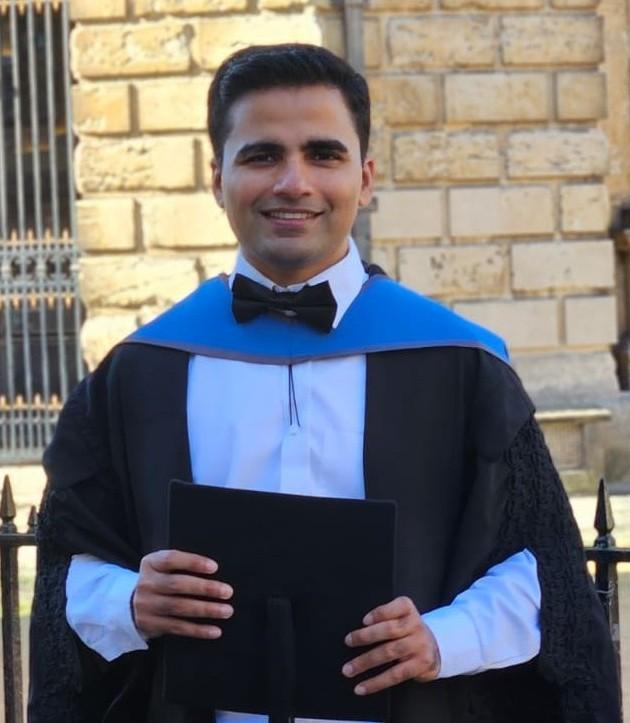
My dissertation was titled “From Legal Child to Media Inmate: Crisis Visibility and the ‘Carceral Child’ in Nepal’s Juvenile Correction-Home Reporting.”
The research grew out of my longstanding interest in criminal justice and children’s rights. Before Oxford, I practised law in Nepal, predominantly in criminal cases, alongside research and consultancy work on human rights, children’s rights, trafficking and access to justice. At Oxford, I became increasingly interested in how people within the justice system are understood when their experiences are mediated through institutions, language and the media.
My dissertation examined how Nepali media represent children in conflict with the law when juvenile correction homes become visible through crises such as escapes, deaths, overcrowding, confrontations and police intervention. Nepal’s legal framework treats these children as rights-bearing individuals who should be rehabilitated rather than punished. I wanted to explore what happens to that legal identity when they are publicly described as “inmates”, “detainees”, “absconders” or “security risks”.
From this emerged the idea of the “carceral child”: a child who remains legally protected as a child but becomes publicly understood primarily through the language of custody, disorder, danger and control. The research showed that this was produced not by individual labels alone, but through the interaction of crisis-focused reporting, official sources, custodial language and the prison-like conditions of some correction homes.
The dissertation therefore allowed me to connect my experience of criminal law with a broader criminological interest in how justice is represented and understood.
Have you published, or do you plan to publish, your findings? If so, what do you think are the wider implications of your research for law and society?
I am currently considering how best to develop the dissertation for publication, particularly by exploring questions that fell beyond the scope of the MSc project.
One of its main implications is that child-friendly justice cannot be understood solely through legislation or institutional design. Although Nepal’s legal framework recognises children in conflict with the law as rights-bearing individuals, public understandings can move in a very different direction when correction homes become associated with crisis, disorder and control.
Language therefore matters. Media reporting does more than describe criminal justice institutions; it can influence how those institutions and the people within them are understood. In the case of juvenile correction homes, repeated crisis reporting can make custody and security more visible than rehabilitation.
These questions extend beyond Nepal. They concern how children in conflict with the law are represented, how digital reporting may reinforce stigma, and whether principles of rehabilitation and child-friendly justice are reflected in public discourse as well as legal texts.
Future research could extend this work to television and social media, audience perceptions, and the experiences of children and families themselves.
How did you find the MSc programme at Oxford? Were there any particular highlights of your time on the programme?
The MSc was an extremely enriching experience, both academically and personally. Coming to Oxford after several years of legal practice challenged me to approach familiar criminal justice questions differently. Rather than focusing primarily on law and individual cases, the programme encouraged me to think critically about institutions, punishment, social structures and the evidence underlying criminal justice policy.
I particularly valued the diversity of perspectives within the Centre. Studying alongside people from different academic, professional and geographical backgrounds continually challenged assumptions and made discussions especially rewarding.
The dissertation was a major highlight because it allowed me to examine an issue from Nepal through a criminological lens. I also valued the opportunity to contribute to research beyond my own project. During the year, I worked as a Research Assistant at the Faculty of Law on research concerning family court responses to child sexual abuse allegations, undertaking literature reviews, case-law analysis and report drafting. I also worked as an LNAT Essay Marker, which offered a different perspective on analytical reasoning and legal education.
More broadly, what I valued most about Oxford was its intellectual environment. There was always a seminar, discussion or conversation capable of making you reconsider an idea. That is something I will carry with me well beyond the MSc.
What advice would you give to prospective applicants looking to apply for the MSc, or to anyone embarking on an independent research project?
I would encourage prospective applicants to approach the MSc with an open mind and a willingness to question their own assumptions. Professional experience is valuable, but one of the strengths of criminology is that it asks you to look beyond familiar ways of understanding criminal justice.
For those coming from law, I would particularly recommend thinking carefully about why criminology. The programme is interdisciplinary, and some of its most interesting questions lie beyond legal rules: why particular systems develop, how institutions operate in practice, and how they are experienced by the people affected by them.
For an independent research project, a focused research question is often more valuable than an unnecessarily ambitious one. A manageable question gives you the space to analyse something deeply rather than trying to cover everything.
I would also encourage students to allow the research to challenge their initial assumptions. Some of the most valuable findings emerge when the evidence takes you somewhere you did not expect.
Finally, make use of the intellectual community around you. Talk to your supervisor and peers, attend seminars and discussions, and share ideas even when they are still developing. Some of my most useful insights at Oxford came from conversations outside the formal structure of the course.
What have you been doing since graduating, and what are your next steps? How do you think the skills and experience you gained throughout your MSc are helping you now, or will help you in pursuing your future ambitions?
Since graduating, I have returned to Nepal and am looking forward to continuing my work across legal practice, teaching and research.
I see Oxford not as a departure from my previous career, but as adding another dimension to it. The MSc gave me a stronger criminological and empirical foundation for understanding issues I had previously encountered mainly through legal practice.
It has changed the questions I ask about criminal justice. Legal practice often requires close attention to the individual case, the law, evidence, arguments and outcome. Criminology encouraged me to look beyond the case to the institutions and structures surrounding it: how certain groups become criminalised or stigmatised, how public narratives shape justice, and how research can inform reform.
Going forward, I hope to combine these perspectives in my work on criminal justice and legal reform in Nepal, while continuing to develop as a researcher and contribute to evidence-based policy.
The MSc has also made pursuing a DPhil at Oxford a much clearer ambition. I would like, in the future, to develop research arising from my experience of legal practice in Nepal and examine those questions using the theoretical and methodological foundations I gained during the MSc.
For that reason, graduation feels less like an endpoint than the beginning of a more defined academic path. I hope eventually to return to Oxford with further experience from practice and develop research that can contribute to a fairer, more effective and responsive criminal justice system in Nepal and beyond.
This interview was conducted in August 2026 by Megan Smith-Dobric (DPhil in Law candidate, Wolfson College, Oxford).