
Regulating AI at Work: Policy Blueprint
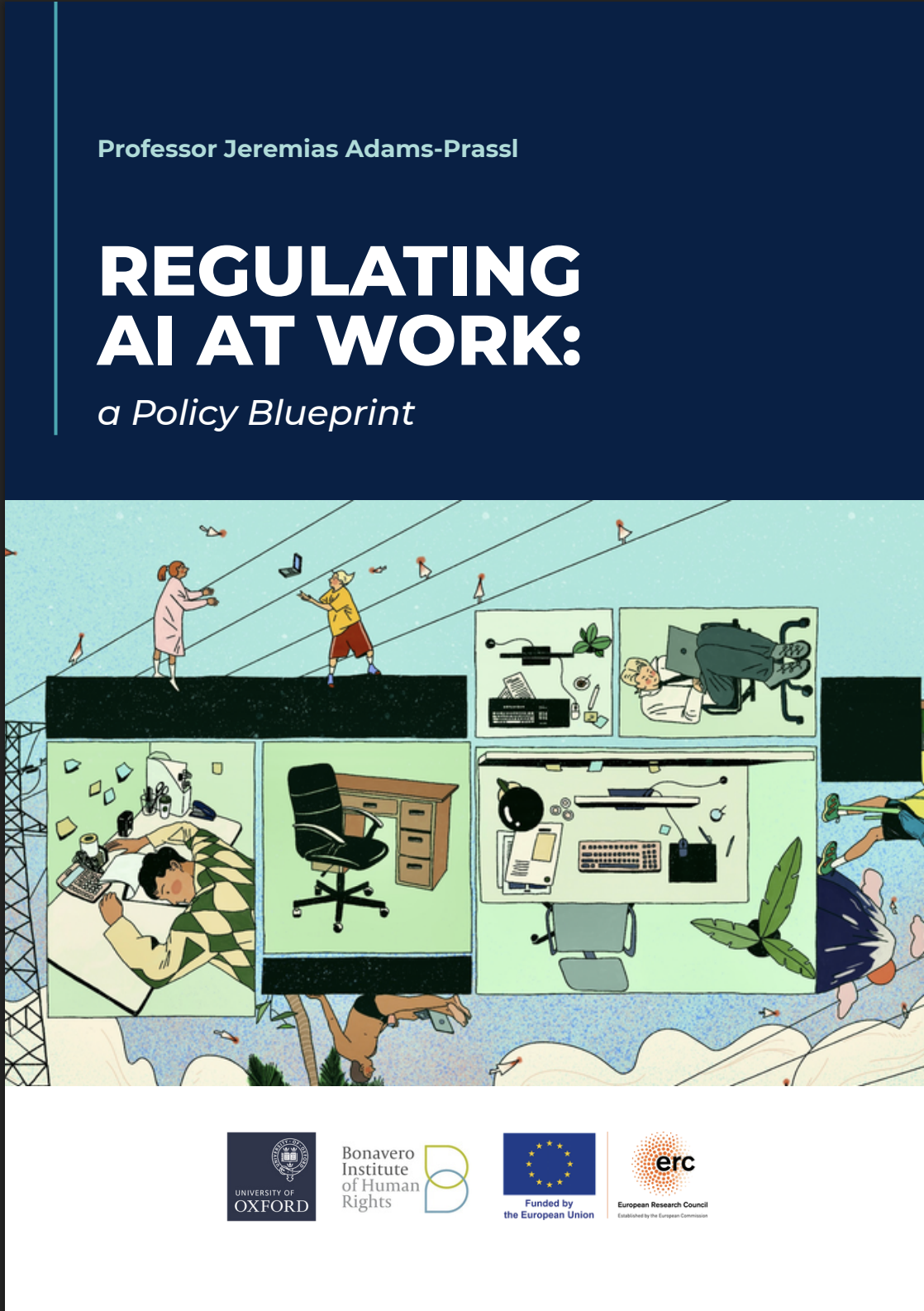
Automated systems, often incorporating AI, are increasingly used in workplaces around the world to make managerial decisions traditionally performed by humans. Algorithmic management systems can impact decisions ranging from hiring, earnings, occupational safety and health, to working time, promotion, and even terminations. While the deployment of algorithmic management is often motivated by the promise of increased efficiency in organisational decision-making, it can also produce new and significant harms for both workers and organisations which are largely unaddressed by existing regulatory frameworks that apply in the workplace.
Drawing on research conducted by the iManage team, led by Professor Jeremias Adams-Prassl, the policy blueprint sets out eight regulatory options to address the gaps identified, and ensure that algorithmic management: respects human and worker rights; promotes organisational efficiency and productivity; and creates an enabling regulatory environment for effective social dialogue.
The Policy Options
By clicking on each policy options below, you will land on a breakdown of the proposed rule, its practical implications, as well as concrete illustrations from jurisdictions across EU and beyond. In doing so, the blueprint illustrates that while more protections are needed, a welter of existing law already provides the platform to build upon. Other jurisdictions' approaches detailed in each option as exemplars can provide inspiration for how to better regulate algorithmic management around the globe.
Q&A on algorithmic management
Explore the Q&A below on the promise and perils of algorithmic management, as well as an analysis of gaps in existing protective regimes.
AI systems are increasingly used in workplaces around the world to make managerial decisions. AI includes a broad range of technologies that produce outputs by uncovering patterns in large datasets. Today, the most frequent use of the term ‘AI’ refers to ‘generative AI’ technologies, such as chatbots. However, AI can also be used to refer to machine learning algorithms, and is frequently integrated with traditional, complex software programmed to make rule-based decisions. In this policy brief, references to AI include all of the above with respect to its deployment as ‘algorithmic management systems’.
Algorithmic management includes:
- the collection or creation of any information (whether identifiable or not) with a view to organising, monitoring, supervising or evaluating work performance or behaviours; and/or
- the use of that information to support, augment or fully automate decisions that affect working conditions, including access to work, earnings, occupational safety and health, working time, promotion and contractual status, and disciplinary as well as termination procedures.
Whilst algorithmic management was first pioneered in the gig economy, it has quickly come to be used across the socio-economic spectrum, from retail and warehouse work to healthcare.
Claims of AI’s capabilities and performance have made the technology appealing to employers facing pressures to increase efficiency and productivity. AI can improve the speed and scale of data processing. If deployed thoughtfully and contextually, AI could help classify and interpret information at speed, increasing the information available to human managers in making workplace decisions. Algorithmic management might also help to improve organisational performance and job satisfaction, e.g., by more smartly pairing workers with work.
Example: BT Group, a telecommunications company, built an algorithm for task allocation to coordinate mobile workers responsible for maintenance and repairs. The algorithmic management system was designed with input from a wide range of stakeholders, including the workers whose work it would help organise. The system allowed the organisation to match work to workers more accurately—producing the hoped-for cost savings and operational efficiency gains, while preserving workers’ ability to have input into their work schedules and respond to ‘unforeseen events’ in the field
Our research suggests that the use of AI in algorithmic management can also produce new harms for both workers and organisations.
Novel privacy harms
Algorithmic management can entail the near-constant collection and analysis of data concerning individuals’ activities and behaviour to create comprehensive profiles of workers and job applicants. Data analysis of these profiles then informs decisions about individuals. Inferences can also be extracted from these profiles to make decisions about future employees. The mass, comprehensive processing of workers’ data also has the potential to blur the distinction between work activities and the private lives of individuals. Algorithmic management can thus create significant stress and negatively impact psychological wellbeing.
Widening of information asymmetries
While increasingly granular and intimate data is collected about individuals, workers know little about what information is being collected or how it is used to inform managerial decisions. This information asymmetry already provides managers with additional bargaining power in negotiations under social dialogue with workers over pay, work assignments, and working conditions.
Example: Productivity monitoring applications rely on the collection of worker data from a wide range of sources, including wearables, often resulting in work intensification, invasions of privacy, stress-related health effects, and unsafe work practices
Loss of human agency
The increasing reliance on AI systems erodes human agency by distancing managers from the ability to fully control managerial decisions. Managerial decisions made without human involvement can alienate workers and violate individuals’ dignity, e.g., in the context of disciplinary decisions. Managers may not always understand the capabilities, functions, and susceptibility to technical failures of the technologies that they purchase, which results in poorer quality decision-making.
When human decision-making processes are supplemented or replaced by AI, particularly those not built ‘in-house’ , responsibility for decisions is also diffused into the AI supply chain—obscuring legal accountability.
Example: Third-party companies are contracted by organisations to screen applicants by running automated searches through large databases of criminal record data. The generated reports frequently contain errors, such as mismatching the subject of the report with another person. These reports undergo minimal, if any, manual review before an employer receives them, with potentially grave consequences for job seekers.
New harms from algorithmic management are unaddressed in certain ways by existing rules that apply in the workplace because of the different scope and purpose of these regulatory frameworks:
- Data protection: data protection laws can go some way towards addressing the new harms presented by AI in algorithmic management. However, current data protection rules contain gaps with respect to collective and relational harms, inaccurate data processing, anonymous data, reliance on consent, and data inferences (Abraha, 2023).
- AI regulation: while algorithmic management systems will typically be classified as ‘high-risk’ systems under the EU AI Act, some technologies may fall outside the scope of the legal definition of AI. As the EU AI Act is designed as product safety legislation, it furthermore does not regulate technologies in a dynamic and contextual approach, and fails to confer meaningful rights on individuals (Kelly-Lyth, 2021).
- Labour law: the EU’s Platform Work Directive only protects individuals working for digital labour platforms in the gig economy, leaving ‘traditional workers’ unprotected from the same harms (Sutterer-Kipping, Tragiannis, Silberman, Adams-Prassl, 2026)
- Discrimination law: our research has demonstrated how biased algorithmic management systems could be addressed by existing discrimination laws. However, there are limits to discrimination law since it operates after the harm has already occurred, and claimants frequently experience evidential challenges (Adams-Prassl, Binns and Kelly-Lyth, 2022; Kelly-Lyth, 2023)
This site is part of a project that has received funding from the European Research Council (ERC) under the European Union’s Horizon 2020 research and innovation programme (Grant agreement No. 947806).
If you have any questions or feedback about this site or our research, please get in touch by emailing ai.work@law.ox.ac.uk.