
Climate mobility explained: key terms
There is no single, agreed set of legal definitions for human mobility in the context of climate change, disasters and environmental degradation. Different terms describe different forms of movement, and some have no legal status, so it matters that they are used carefully. The definitions below draw on those used by international organisations, notably the International Organization for Migration (IOM), alongside the Institute’s own working terms.
Climate mobility
An umbrella term for the full range of movement, and lack of movement, caused or influenced by climate events: rapid onset events, such as storms and floods, and slow onset events, such as sea-level rise and desertification. It includes temporary and permanent migration, displacement, planned relocation, and immobility. It is close in meaning to “human mobility” in the context of climate change (below). The Institute uses it as a working term; it has no legal status.
Human mobility
“A generic term covering all the different forms of movements of persons”, which reflects a wider range of movements than the term “migration” (IOM, 2019). In the context of climate change, the term is used in the work of the UN Framework Convention on Climate Change (UNFCCC), including the Warsaw International Mechanism on Loss and Damage. There it is understood to cover the three forms of “climate change induced” movement named in the 2010 Cancun Agreements: displacement, migration and planned relocation. It is increasingly used because organisations working on different types of movement can share it.
Habitability
Whether a place can continue to support a safe and dignified life and livelihoods, having regard to the availability of water, food, shelter, income and services, and to safety from climate events. Habitability is a matter of degree rather than a threshold, and it can decline gradually, long before a place is submerged or abandoned. It is shaped by governance as well as geography: the same flood or drought may be survivable in one place and far more damaging in another, often because of differences in the measures taken to sustain life and livelihoods. The Institute uses habitability as a lens for understanding climate mobility; it is not a legal status. See also section E.
Climate change
Long-term shifts in temperatures and weather patterns, including changes in how often climate-related hazards happen, how severe they are and how long they last. It is driven mainly by human activities that increase greenhouse gases in the atmosphere.
Climate event
In these explainers, both rapid onset events, such as storms and floods, and slow onset events, such as sea-level rise and desertification. The term is used broadly, and also covers environmental changes that cannot necessarily be attributed to climate change, such as land degradation, deforestation, biodiversity loss and resource depletion.
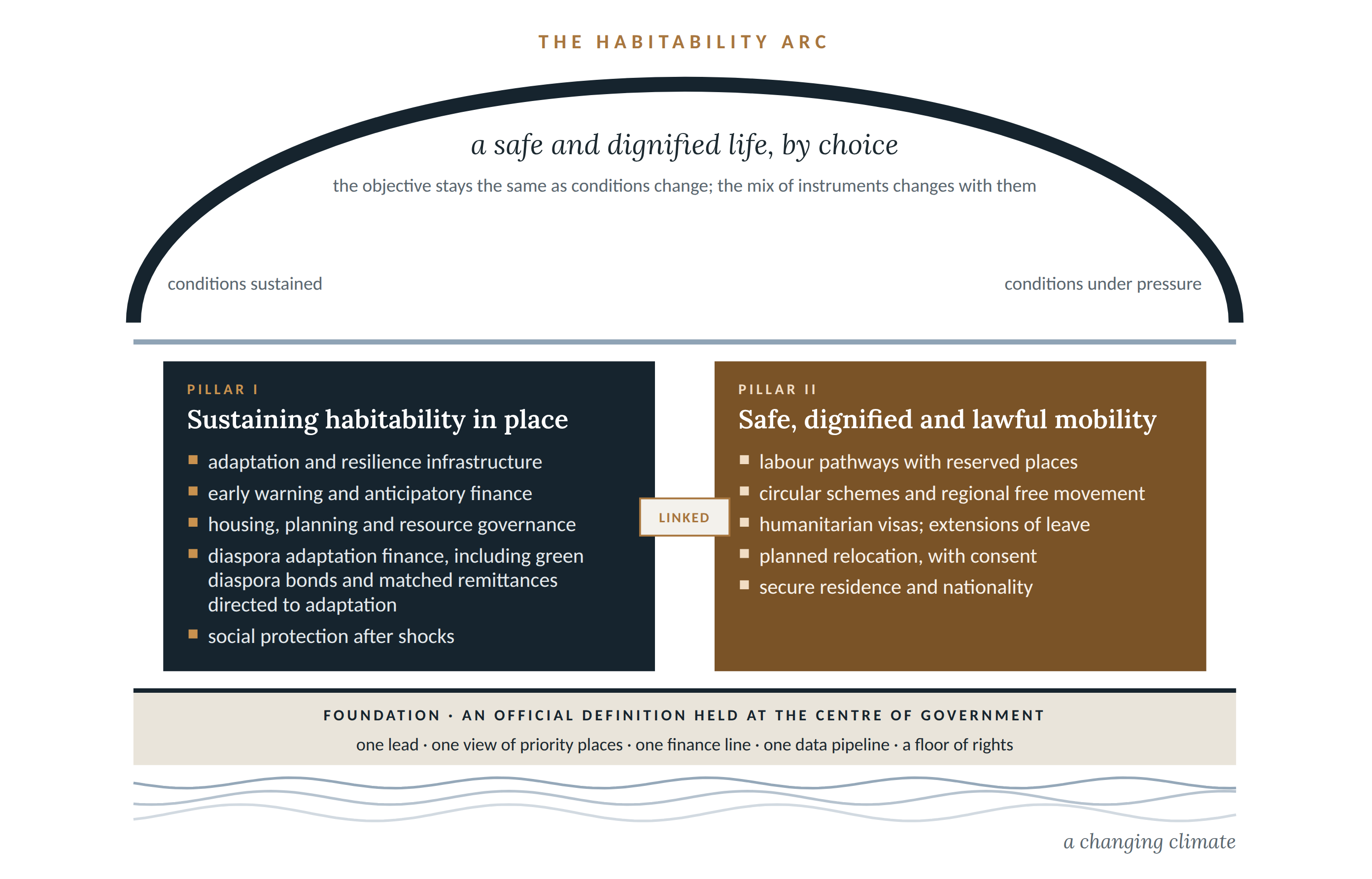
The habitability arc
The Institute’s framework for describing the changing relationship between people, places and climate. As conditions come under pressure, the mix of policy responses that people need changes, but the objective stays the same: a safe and dignified life and livelihood, by choice. Within the arc, two pillars of policy instruments operate together. Pillar I sustains habitability in place; Pillar II enables safe, dignified and lawful mobility. Neither is held in reserve for when the other fails.
Climate vulnerability
How exposed and susceptible individuals, communities, livelihoods, territories or ecosystems are to the harmful effects of climate events. It takes account of exposure alongside a community’s capacity to anticipate, cope with, adapt to and recover from those events. Unequal access to resources, services, rights and decision-making all affect vulnerability. Vulnerability belongs at the centre of responses: the most vulnerable may be those who are unable to move, or who do not move (see “Trapped populations”).
Environmental migration
“The movement of persons or groups of persons who, predominantly for reasons of sudden or progressive changes in the environment that adversely affect their lives or living conditions, are forced to leave their places of habitual residence, or choose to do so, either temporarily or permanently, and who move within or outside their country of origin or habitual residence” (IOM, 2019).
Climate migration
“The movement of a person or groups of persons who, predominantly for reasons of sudden or progressive change in the environment due to climate change, are obliged to leave their habitual place of residence, or choose to do so, either temporarily or permanently, within a State or across an international border” (IOM, 2019).
Climate migration is a subcategory of environmental migration: it is environmental migration where the change in the environment is due to climate change. It is an IOM working definition, used for analysis and advocacy, and has no specific legal value. The term appears in the Cancun Agreements adopted by Parties to the UNFCCC in 2010, and the World Bank has used it in projecting future movement due to the adverse effects of climate change.
Disaster
A serious disruption to the functioning of a community or society, caused when a hazard, such as a flood or storm, affects people who are exposed and vulnerable to it, and leading to human, material, economic or environmental losses. A disaster can exceed a community’s ability to cope using its own resources (UNDRR, 2017).
Disaster displacement
Situations where people are “forced or obliged to leave their homes or places of habitual residence as a result of a disaster or in order to avoid the impact of an immediate and foreseeable natural hazard” (Nansen Initiative, 2015). Such displacement happens because people are exposed to a natural hazard at a time when they are too vulnerable, and lack the resilience, to withstand its impacts.
The term is mostly used for forced movement triggered by sudden-onset events. Where people cross into another country, “cross-border disaster displacement” is sometimes used. The Platform on Disaster Displacement uses it as an umbrella term, and the Internal Displacement Monitoring Centre (IDMC) uses it in its annual estimates of new internal displacements linked to disasters.
Climate-related displacement
A form of climate mobility in which people are forced or obliged to leave their homes because of rapid onset or slow onset climate events. The Institute uses it as a broader term than “disaster displacement”, which is mostly used for sudden-onset events.
Internal climate displacement
Climate-related displacement that takes place within a country’s borders. Most displacement linked to disasters and climate change is internal, and it affects high-income as well as low-income countries. People displaced within their own country are covered by the UN Guiding Principles on Internal Displacement.
Planned relocation
“In the context of disasters or environmental degradation, including when due to the effects of climate change, a planned process in which persons or groups of persons move or are assisted to move away from their homes or place of temporary residence, are settled in a new location, and provided with the conditions for rebuilding their lives” (IOM, 2019).
The term is generally used for relocations carried out within national borders under the authority of the State. It describes a long process, which lasts until relocated people are part of all aspects of life in the new location and no longer have needs or vulnerabilities arising from the relocation (IOM, 2019; Georgetown University, UNHCR and IOM, 2017).
Trapped populations
People “who do not migrate, yet are situated in areas under threat, [...] at risk of becoming ‘trapped’ or having to stay behind, where they will be more vulnerable to environmental shocks and impoverishment”. The idea applies in particular to poorer households, which may not have the resources to move and whose livelihoods are affected (IOM, 2019).
In the context of climate change, some people may be unable to move because of a lack of resources, disability or social reasons, such as gender. Others may choose not to move for cultural reasons, such as ancestral links with their land.
Climate adaptation
In the context of human mobility, measures that help people to stay safely where they are, and mobility measures such as temporary or permanent migration and planned relocation, taken to reduce or manage climate-related risks and impacts.
Climate migrant
Term used with care.
Sometimes used to describe people who move because of climate change or environmental hazards. Some organisations use it, and IOM uses “climate migration” as a working term (above). The Institute generally prefers “climate mobility”, because “climate migrant” does not show whether movement is internal or across borders, temporary or permanent, chosen or forced, and it has no legal definition.
Climate refugee
Term to avoid. Not a legal term.
“Climate refugee” and “environmental refugee” are terms often used in the media and by campaigners to draw attention to the situation and needs of people uprooted by disasters, climate change and environmental degradation. Their situation and needs can be similar to those of refugees, for example where people cross a border after a disaster and need protection and assistance. But people who move for environmental reasons do not fall squarely within any one category of the existing international legal framework, and these terms have no basis in international refugee law. Under the 1951 Refugee Convention, a refugee is someone with a well-founded fear of persecution for reasons of race, religion, nationality, membership of a particular social group or political opinion.
There is a growing consensus among international agencies, including IOM and UNHCR, that these terms should be avoided. They can be misleading: most environmental migration is internal and not necessarily forced, and using the terms could undermine the international system for protecting refugees. Some people affected by climate events may still qualify as refugees, for example where persecution and climate harm overlap, or under the broader regional definitions used in Africa and Latin America. Everyone who moves in the context of environmental change is protected by international human rights law, and people displaced within their own country are also covered by the UN Guiding Principles on Internal Displacement, to the extent that their country has given effect to them.
About the Institute
The Institute for Law and Policy on Climate Mobility brings together world-leading experts to research, inform, and advise on rights-based responses to climate mobility. We seek to mainstream climate mobility in legal and policy frameworks as the centrepiece to climate resilient governance structures.
How to cite
Iengar, S. (2026) Climate mobility, explained. Explainers. Oxford: Institute for Law and Policy on Climate Mobility, University of Oxford. Available at: https://www.law.ox.ac.uk/border-criminologies/institute-for-law-and-policy-on-climate-mobility