
Habitability: the lens through which climate mobility should be understood
This position statement is produced by The Institute for Law and Policy on Climate Mobility, which is part of Border Criminologies. This position statement can also be viewed as a pdf.
In brief
Climate change is already reshaping where and how people live. Some people move, within their own country or across borders; some relocate as whole communities; most stay, by choice or because they cannot leave.
Climate mobility is usually presented as a question of who moves and where they arrive. The Institute’s position is that it is better understood through the lens of habitability: whether places and the people in them can continue to sustain a safe and dignified life as the climate changes.
Through that lens, climate mobility calls for two linked pillars of policy response that operate together: helping people to stay safely where they are, and making movement safe, lawful and dignified when it happens.
What is climate mobility?
A short guide to the term and to what the evidence shows
Climate mobility is the full range of mobility and immobility caused or influenced by rapid onset climate events, such as storms and floods, and slow onset events, such as sea-level rise and desertification. It includes temporary and permanent migration, forced displacement, planned relocation, and immobility.
We use ‘mobility’ rather than ‘migration’ because policy that looks only at migration excludes most of the people affected.
We prefer not to use the term ‘climate migrant’ because it is ambiguous and does not explain whether movement is internal or across borders, temporary or permanent, chosen or forced.
Four situations, four responses
It helps to distinguish four situations, each of which calls for a different response:
- Migration as adaptation: people move, often temporarily, to reduce risk and possibly to diversify income.
- Forced displacement: people are compelled to leave their homes.
- Trapped populations: people remain in high-risk places because they cannot move.
- Politically exploited movement: movement, or stories about it, used by others for strategic, criminal or political ends.
Five things to know
What the evidence shows
Most movement happens within countries
The large majority of climate-related movement takes place inside national borders.
Many of the most affected cannot move at all
Moving requires resources, good health and support networks. The people most exposed to displacing climate events often have the least of these, and remain in harm’s way.
Climate rarely acts alone
Climate change interacts with livelihoods, housing, services, governance and conflict. The main risk is not movement itself, but the strain on the systems that allow people to stay safely, adapt locally or move by choice.
Moving can be a way of adapting
Seasonal work elsewhere, remittances sent home and planned moves can all help people cope with climate events. Strengthening people’s capacity to adapt improves the degree of choice they have about whether and how to move.
Acting early costs less
Investment in resilience typically returns between two and ten times its cost. Responding after displacement is slower, more expensive and harder on the people affected.
Beyond the migration frame
Why the way climate mobility is framed, determines what gets done
Public discussion of climate mobility has tended to settle on one of two frames. The first presents it as a coming wave of cross-border migration, to be contained or managed. The second presents it as a humanitarian emergency, to be met once people have been displaced. Both frames fix attention on movement, and on the moment at which movement becomes visible.
Neither describes most of what is happening. Most climate-related movement takes place within countries rather than across borders, and many of the people most exposed to climate events are unable to move at all because they lack the resources to do so. Receiving towns and cities absorb much of the pressure, with little support.
The frame matters because it determines what receives attention and funding. A migration frame directs both to borders and to the aftermath of displacement. It leaves out people who stay, people who cannot leave, and the communities that receive newcomers. It also separates climate, migration, development and humanitarian work, that is in fact addressing different parts of the same problem.
Habitability as a lens
The Institute frames climate mobility through the lens of habitability. Habitability is whether a place can continue to support safe, dignified life and livelihoods, having regard to the availability of water, food, shelter, income and services, and to safety from climate events. It is a matter of degree rather than a threshold, and it can be lost gradually, long before a place is submerged or abandoned.
Habitability is not fixed by geography. The same flood or drought may be survivable in one place and ruinous in another; what usually differs is the quality of the governance measures taken to sustain the conditions of life and livelihoods. The scientific literature now treats habitability as multidimensional and relational, shaped by economic, political and social conditions, experienced differently by different people in the same place, and dependent on a place’s connections to others through markets, remittances and movement.
Seen through the lens of habitability, climate mobility is the way in which climate events show themselves in human mobility and immobility. The question for policy becomes: what will it take for people to continue to live a safe and dignified life, whether they stay or move?
Our approach: the habitability arc
Climate mobility as a question of safe and dignified lives
The Institute starts from a simple question: what law and policy frameworks are required to sustain a safe and dignified life and livelihoods, in a changing climate? We call this habitability. It depends on water, food, shelter, income and services, and on safety from climate events.
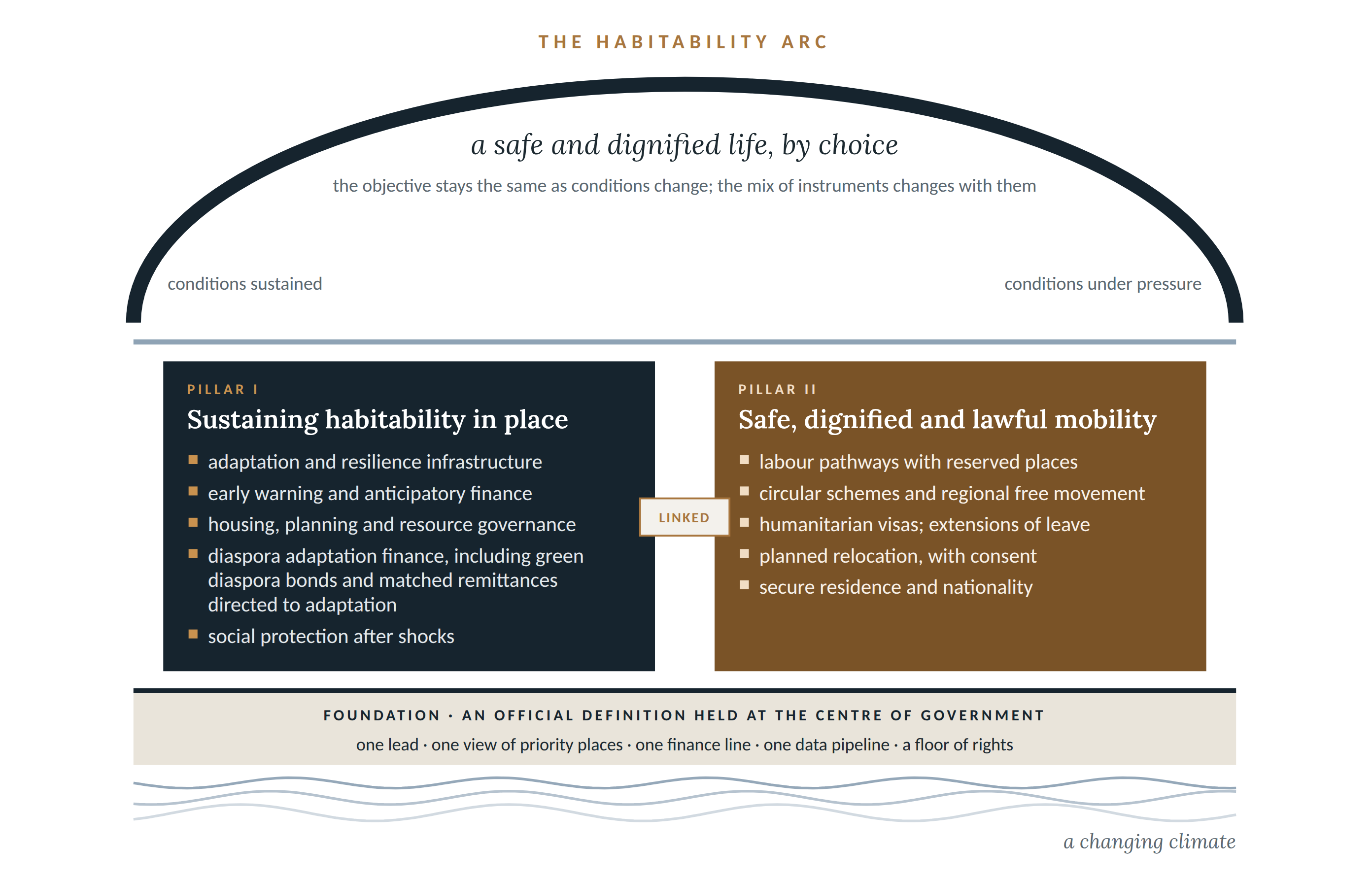
The habitability arc describes a changing relationship between people, places and climate. As conditions come under pressure, the combination of policy responses that people need changes, but the objective does not: a safe and dignified life and livelihood, by choice.
Two pillars within the habitability arc
Within the arc, two pillars of policy instruments co-exist. Pillar I sustains habitability in place, through adaptation, early warning and anticipatory finance, housing and planning, and the governance of natural resources. Pillar II enables safe, dignified mobility, through labour pathways, circular and regional free movement, humanitarian routes and extensions of leave, and planned relocation carried out in participation with affected communities as a measure of last resort. The pillars are not alternatives, and neither is held in reserve for when the other fails. Where adaptation can no longer secure a safe and dignified life, for some people or in some places, safe routes to move are the means by which habitability is safeguarded. Governments have already recognised as much in the Global Compact for Migration.
Our principles
What guides the Institute’s work, and where other organisations can make a difference
Climate mobility is a question of habitability, not borders
It concerns whether places and people can continue to sustain a safe and dignified life and livelihoods, not only whether people cross borders. It includes internal movement, immobility and the communities that receive newcomers.
Staying and moving belong in one framework
Instruments that sustain habitability in place and instruments that enable safe, dignified mobility should be designed together, focused on the same places and linked so that each strengthens the other.
Choice is the measure of success
Responses succeed when people are able to remain in safety or move in safety, on terms they have a part in determining, including those who choose to stay.
Rights and communities come first
Planned relocation should be a last resort, carried out only with communities, rather than imposed upon them. Pathways should be fair, non-discriminatory and protective of workers. Affected communities should shape decisions about their own places.
Governments should own and define the agenda now
The centre of Government (the Cabinet Office or equivalent) should adopt an official definition of climate mobility and assign the agenda across departments, giving each clarity of their role. This should be done now, in full preparedness, and well before crises are reached.
How others can help
- Use precise language: speak of climate mobility.
- Include people who cannot move and the communities that receive newcomers.
- Connect climate, migration, development and humanitarian work around the same places.
- Bring affected communities into discussions and decisions about their own places and futures.
- Ask Governments to adopt an official definition of climate mobility and provide clarity on each department’s role.
About the Institute
The Institute for Law and Policy on Climate Mobility brings together world-leading experts to research, inform, and advise on rights-based responses to climate mobility. We seek to mainstream climate mobility in legal and policy frameworks as the centrepiece to climate resilient governance structures.
Further reading: Climate mobility, explained (2026) and the Policy Series, Actionable climate mobility policy responses for national government ministries (2026).
How to cite
Iengar, S. (2026) Habitability: the lens through which climate mobility should be understood. Position Statement. Oxford: Institute for Law and Policy on Climate Mobility, University of Oxford. Available at: https://www.law.ox.ac.uk/border-criminologies/institute-for-law-and-policy-on-climate-mobility
Contact: sangeetha.iengar@crim.ox.ac.uk