
Sandra Fredman, a legal giant, and the first woman law professor at the University of Oxford, retires

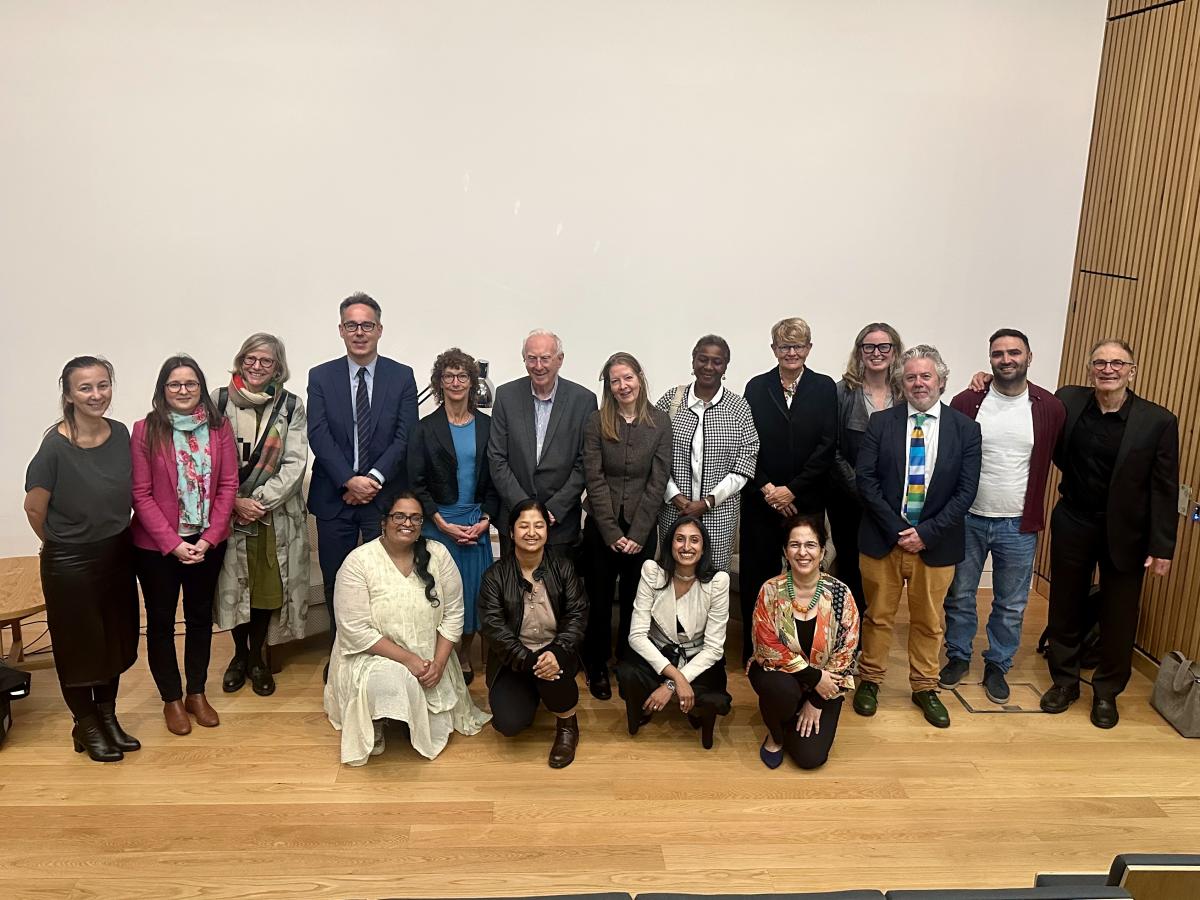
On 14 October 2026, the Faculty of Law, the Oxford Human Rights Hub and the Bonavero Institute of Human Rights hosted an event marking the retirement of Professor Sandra “Sandy” Fredman FBA KC (Hon) from the Statutory Chair of the Laws of the British Commonwealth and the USA. The event celebrated her many contributions to the fields of Human Rights and Equality Law, and included a panel discussion on “Transforming Human Rights in a Transformed World”.
Reflecting on Sandra Fredman’s legacy
The event was opened with tributes to Professor Sandra Fredman and her work by Shreya Atrey (Faculty of Law, University of Oxford), Meghan Campbell (Birmingham Law School), Alan Bogg (University of Bristol), John Armour (Faculty of Law, University of Oxford) and Rachel Murray (Bonavero Institute of Human Rights). They reflected on the immense community-building work Sandra has done in supervising over forty graduate students, launching the Oxford Legal Assistance, the Oxford Pro Bono Publico, the Oxford Human Rights Hub and setting up early maternity leave systems and sexual harassment guidelines at Oxford.
“In the early noughties, few women law fellows existed at the Faculty of Law. Since then, Sandy has contributed to building a space for others to come through the door and thrive at Oxford, including by teaching, supervising and mentoring many of her now colleagues at the Oxford Faculty of Law ,” reflected Shreya Atrey. “All this, while raising three children with her incredible husband Alan Stein, and researching, teaching and practicing across three fields of law: labour, equality and human rights law, across domestic, regional and international law.”
Transforming human rights in a transformed world
Başak Çalı (Bonavero Institute of Human Rights) moderated a conversation between Sandra Fredman, former Justice Susanne Baer (Humboldt University Berlin, University of Michigan Law School, LSE, Federal Constitutional Court of Germany) and Justice Steven Majiedt (Constitutional Court of South Africa).
Their conversation traced the challenges that face human rights lawyers in 'transforming' human rights in a 'transformed world'. The task of transforming the world through human rights is formidable especially in a world defined by inequality: a dimension Judge Baer described as 'the social question' which defines the fraught politics around the world and Judge Majiedt described as inescapable for judges. Both examined creative ways in which constitutions - whether liberal or transformative - and constitutional lawyers and judges - can continue to activate human rights for, what Sandra Fredman described as the mission of law, 'correcting imbalances in social power'. She charted the path for embarking on this formidable task of transforming human rights in a transformed world by sharing her latest research on centring care in public law — including centring care in the spaces and communities we do public law in, such as our own at the University of Oxford.