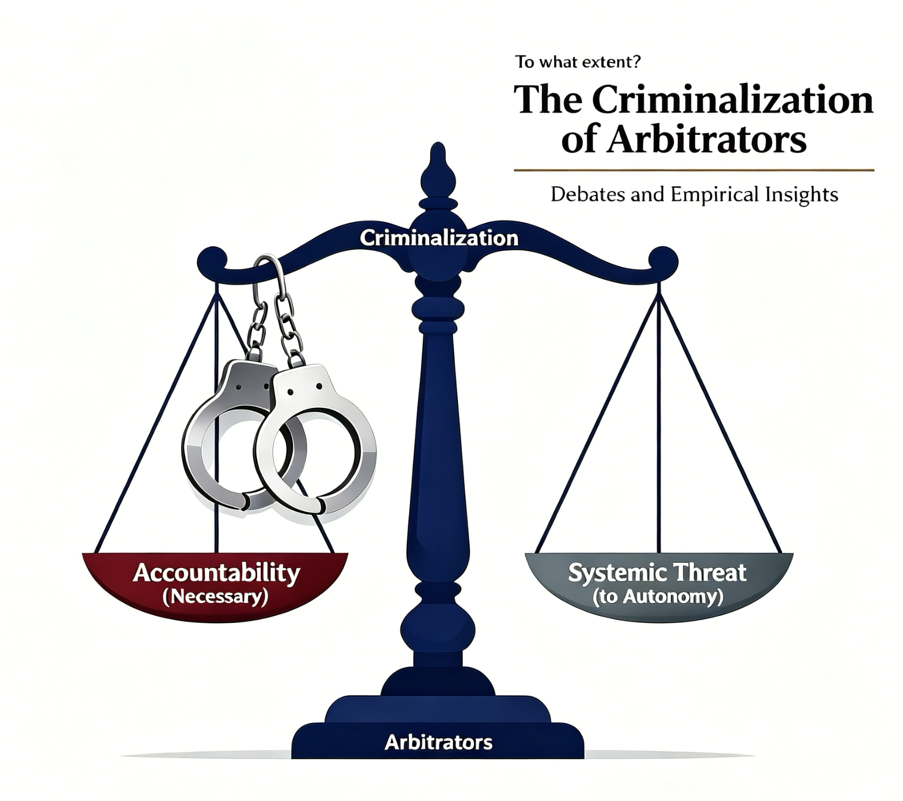
The arbitration community has traditionally argued that arbitrators should be shielded from criminal liability for actions performed in their professional capacity. However, a global trend has emerged wherein criminal law is increasingly used to regulate arbitrator behavior. Several controversial cases, where arbitrators have faced criminal charges for their professional conduct, have sparked intense debate. Central to this discussion is whether immunity from criminal prosecution is necessary to ensure the fairness of arbitral proceedings, and the degree to which arbitrators can be trusted to self-regulate.
This topic reflects a fundamental tension: balancing the prevention of arbitrator misconduct against the preservation of arbitral independence. It also highlights a stark disconnect between the arbitral community’s preference for self-regulation and the reality of domestic legal intervention. Despite the urgency of this debate, there is a notable lack of empirical research on how these criminal provisions are implemented. By analyzing a comprehensive dataset of criminal prosecutions in China—a jurisdiction uniquely relevant due to its specific legislation targeting arbitrators—alongside high-profile global cases, this study reveals how arbitrators are criminalized in practice. As the first empirically grounded analysis of its kind, this research provides valuable insights for scholars and policymakers navigating this unharmonized regulatory landscape.

 Add to calendar