Competition Law and Democracy Network
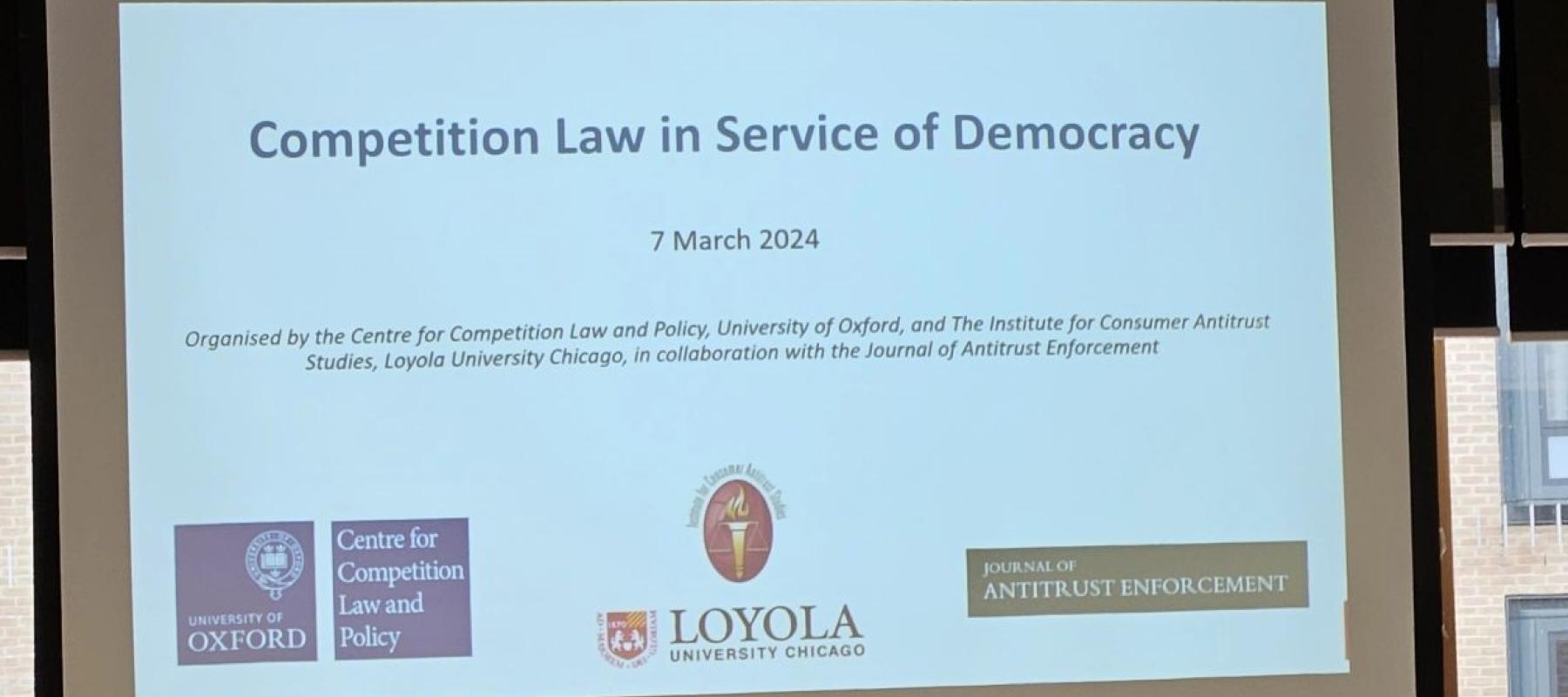
The Competition Law and Democracy Network was established to foster deeper exploration into the multifaceted relationship between competition law, market structures, and democratic governance. Inaugurated on 7 March 2024 during a conference titled Competition In Service of Democracy at the Oxford Centre for Competition Law and Policy, the network seeks to emphasise viewing competition policy as not just an economic tool but a safeguard for democracy.
In an era where dominant digital platforms shape the flow of information and influence public discourse, competition policy is a vital tool for reinforcing democratic principles. Practices like microtargeting, disinformation, and the spread of harmful content contribute to polarization and undermine trust in democratic institutions. Competition law plays a key role in ensuring market fairness, preventing undue concentrations of power, and supporting democratic principles such as freedom of expression and pluralism.
The Competition Law and Democracy Network invites scholars, practitioners, and policymakers to participate in ongoing discussions, share research, and contribute to advancing the study of how competition law can reinforce democratic principles and institutions. To stay informed about upcoming research and events or to join the network, please email democracy-and-competition-subscribe@maillist.ox.ac.uk.
Past event:
2026:
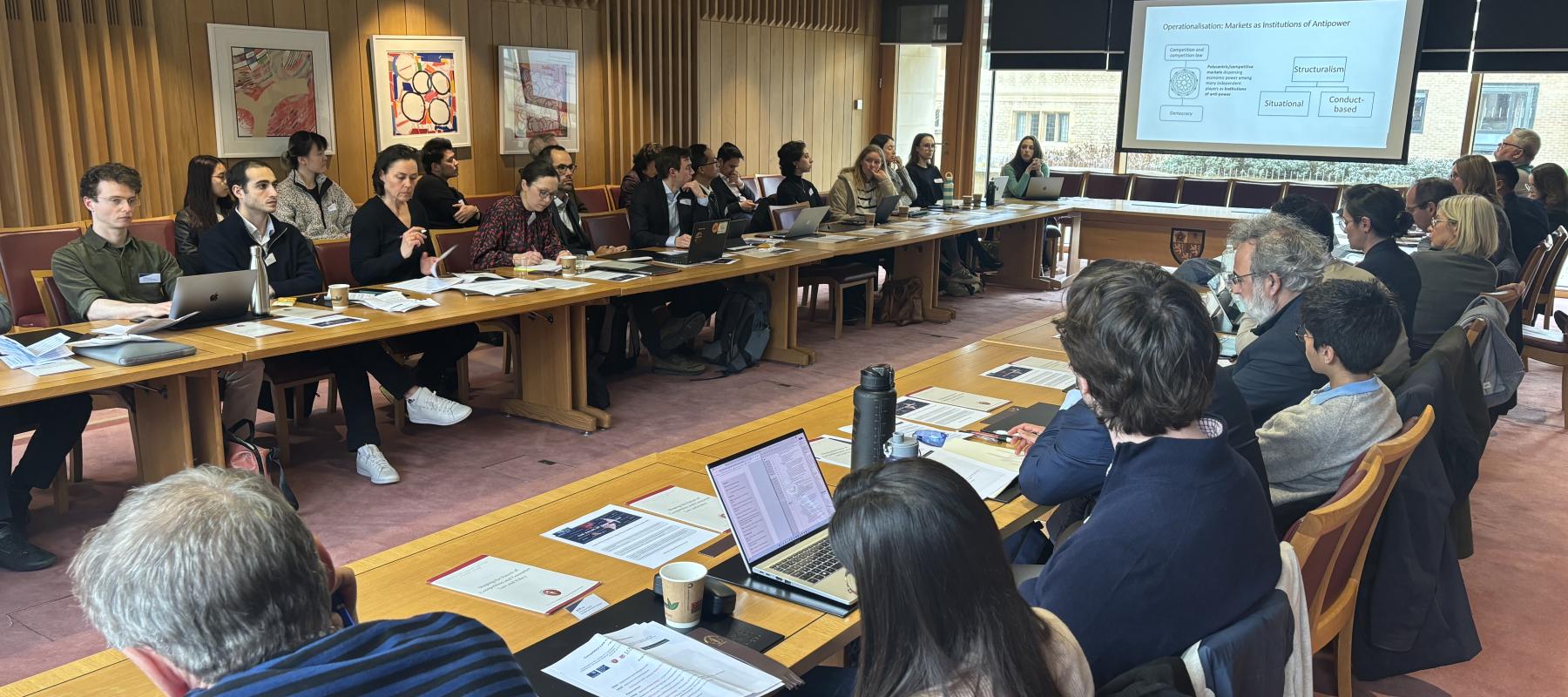
The CCLP was delighted to host the second workshop of the Competition Law and Democracy Network, focusing on “Competition, Politics and Democratic Governance.”
Since our previous event just two years ago, geopolitical and national developments have further emphasised the relevance and urgency of the debate on the relationship between competition law and democracy. Against this evolving backdrop, the workshop brought together leading scholars for a timely-as-ever discussions on how market governance interacts with political power and democratic institutions.
Papers presented included:
- Elias Deutscher – Markets as Institutions of Anti power
- Vincent Martenet – Separation of Powers and Antitrust
- Maciej Bernatt – Politicization of Competition Agencies
- Or Brook – Responsive Priority-Setting in Competition Law Enforcement
- Edith Loozen – The Democracy Manual to Antitrust: Time to Revisit the Prevalent More Economic Approach
- Maurice E. Stucke – AI, Antitrust and the Marketplace of Ideas
- Yossi Nehushtan – Democracy and the Rule of the Well-Informed Majority
During the session, we were fortunate to have insightful comments from Laura Phillips Sawyer, Barak Orbach, Joerg Hoffmann, Julian Nowag, Andrea Piletta Massaro, Spencer Weber Waller, Magali Eben, Elisabetta Frontoni, Danielle Pamplona, and Beatriz Assad.
2024:
On 7 March 2024, the Oxford Centre for Competition Law and Policy, in collaboration with The Institute for Consumer Antitrust Studies, Loyola University Chicago, and the Journal of Antitrust Enforcement, hosted a conference on Competition In Service of Democracy.
Papers presented, included:
Spencer Weber Waller - Loyola University Chicago, on 'Principles for a More Democratic Competition Policy'
Edith Loozen - Amsterdam Center for Law & Economics, on ‘How democracy defines competition law’
Laura Phillips-Sawyer - University of Georgia, on 'Reimagining Market Power: The Contested Parameters of American Democracy, Antitrust Enforcement, and Economic Thought since WWII'
Elias Deutscher - UEA & European Commission, on 'Markets as Institutions of Antipower'
William E. Kovacic - George Washington University, on 'Competition Policy, Democracy and the Military Industrial Complex'
Kati Cseres - University of Amsterdam, on 'The “democracy puzzle” of EU competition law'
Maciej Bernatt - University of Warsaw, 'Democracy and Competition Law as the Spheres of Mutual Influence'
Yossi Spiegel - Tel Aviv University, on 'Economic insights on Competition and Democracy'
Ariel Ezrachi - CCLP, and Viktoria H.S.E. Robertson - Vienna University of Economics and Business, on 'Can Competition Law Save Democracy? - Reflections on Democracy’s Tech-Driven Decline and How to Stop It'