

“Anti-inflammatory politics” and the abolitionist care commons
Speaker(s):
 Add to calendar
Join us in welcoming Melanie Brazzell's in the last week of the term! Note that we will meet in Seminar Room E at Manor Road, as there are works at the Centre for Criminology that week.
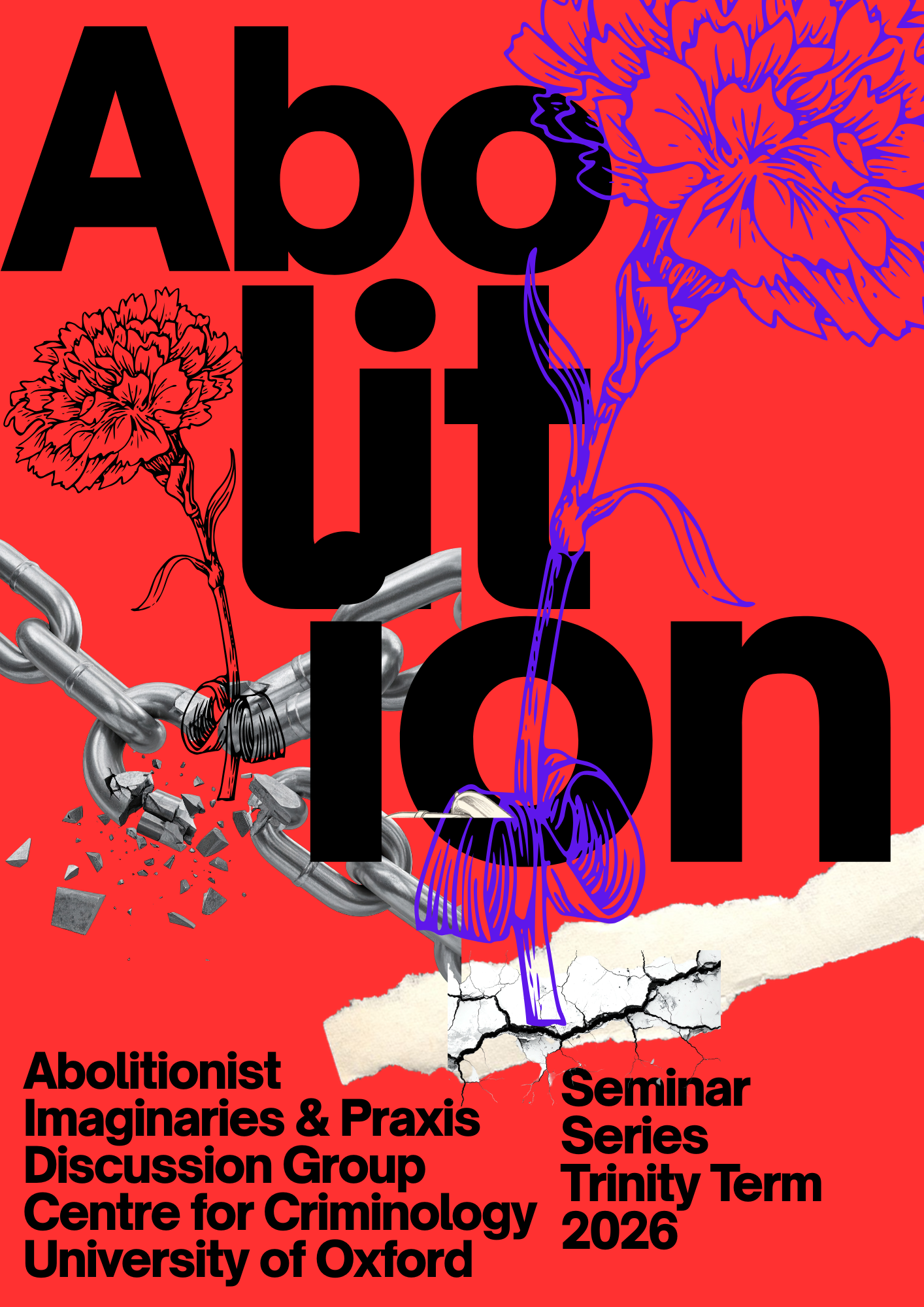
Abstract: In this project, I draw on my distinction between the negative security articulated in carceral logics of punishment and the positive safety expressed in abolitionist concepts of care and accountability. However, recent scholarship on “carceral care” (Hwang 2019) has shown how the boundaries between these two – carcerality and care – can be unstable. If, as philosopher Iris Marion Young argues, the state’s dual faces as protector and punisher are inseparable, the lines between the state’s punitive coercion and social welfare care are often blurred in sectors like education, healthcare, disability services, family and child welfare, and housing. This talk explores how abolitionist organizers liberate care from both social welfare and carceral logics, advancing a Black feminist approach to care as healing justice and creating a “care commons” beyond the state. My participatory research collaboration with Restore Oakland Inc. in California illustrates this approach by coupling individual and structural level health in what we call an "anti-inflammatory politics” that situates healing as both the ends and the means of our organizing.
Melanie Brazzell, PhD, is a postdoctoral fellow at the Civic Power Lab at Harvard University and a fellow at the Criminal Law and Justice Center at UC Berkeley Law School. They are currently finishing their book manuscript on the pasts, presents, and futures of the movement for transformative justice, exploring community-based, non-punitive responses to gender-based violence.
Theme:


