

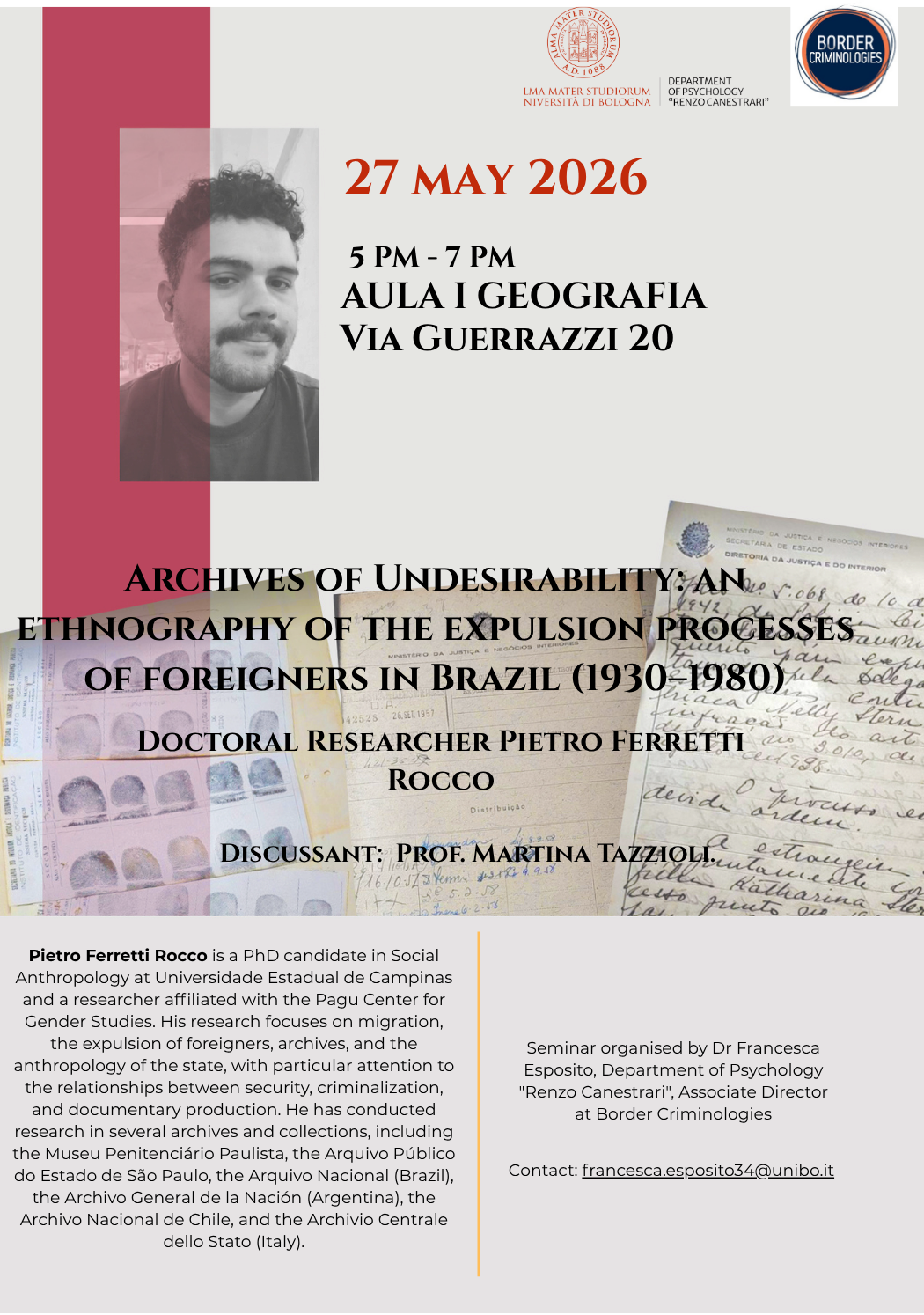
Archives of Undesirability: an ethnography of the expulsion processes of foreigners in Brazil (1930–1980)
Associated with:
 Add to calendar
Pietro Ferretti Rocco, PhD candidate in Social Anthropology at Universidade Estadual de Campinas and researcher affiliated with the Pagu Center for Gender Studies.
Venue: Aula I Geografia, Via Guerrazzi 20, Bologna
Please join us for a seminar co-organized by the Department of Psychology “Renzo Canestrari” at the University of Bologna and the Border Criminologies network. While the seminar will be held in person, online participation is also allowed with prior registration. Please register here (registrations will be open until May 26th)
Abstract: This research analyzes expulsion processes carried out by the Brazilian State between 1930 and 1980, based on an ethnography of archives and administrative, police, and legal documents collected at the National Archive and the Public Archive of the State of São Paulo. Expulsion is a legal category that has existed in Brazil since the mid-nineteenth century and became consolidated in the first decade of the twentieth century, with the aim of forcibly removing immigrants deemed undesirable who had committed some type of crime. The “logic of expulsion,” however, became diffused across security apparatuses and operated (and still operates) as a dispositif that juxtaposes criminal and administrative procedures, materializing state-national imaginaries and geopolitical hierarchies.
Part of the specialized literature has focused on the turn of the nineteenth to the twentieth century. By advancing chronologically into subsequent decades, this study seeks to broaden this scope by examining the periods of the Estado Novo, the Military Dictatorship, and the Foreigner Statute (Law No. 6,815/1980), which remained in force in Brazil until 2017 and carried with it conceptions that framed the immigrant as a suspicious and dangerous individual, subject to expulsion.
The analysis highlights important continuities and discontinuities in state practices of mobility control. An important point is that the expulsion process itself produced inequalities. In addition to being frequently associated with long periods of incarceration, many of these processes did not result in the definitive forced removal of individuals from the national territory. This generated situations in which individuals were formally considered expelled, remained in Brazil, yet had no possibility of access to formal employment, stable housing, or basic rights, as they were officially classified as “expelled.” Thus, I propose to shed light on how expulsion processes were constructed in Brazil between 1930 and 1980, as well as on the continuities and discontinuities of these practices in relation to the present, in which expulsion remains an active dispositif within Brazilian migration governance.
Theme:


