

Bonavero Report Launch: The Absolute Prohibition of Refoulement and Exceptional Circumstances
Speaker(s):
Associated with:
Notes & Changes
This event will be an online seminar. Click here to register.
 Add to calendar
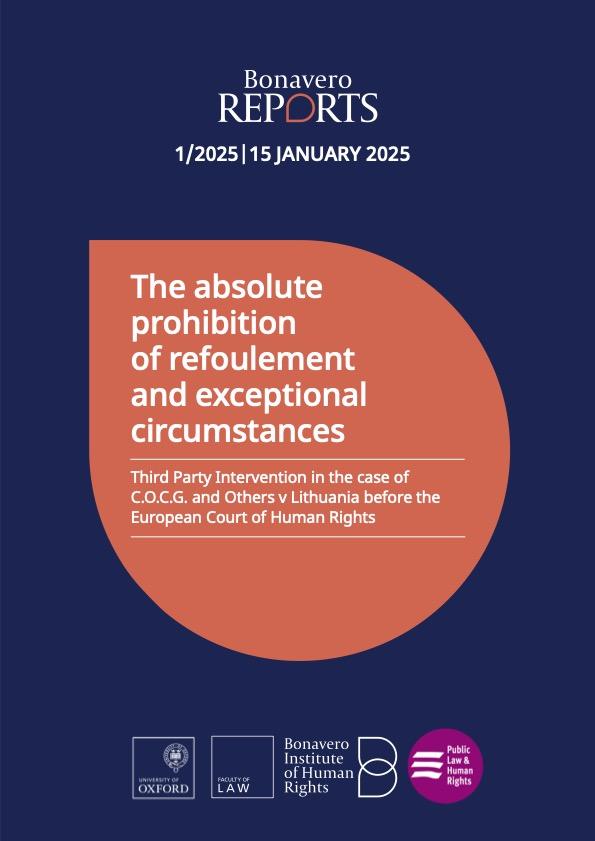
Pushbacks at Europe’s land and sea borders have been well documented in the last decade. In recent years, exceptional political circumstances, such as the facilitation of the cross-border movement of migrants and refugees by one group of states into the territory of another have been put forward as a reason for these pushbacks. The violations of the absolute prohibition of refoulement, enshrined both in international refugee law and international human rights law (as well as fundamental rights protections under many constitutions) brought about by pushbacks in Europe’s borders have also given rise to important litigation and accountability efforts before domestic and international courts and UN human rights treaty bodies and UN special procedures.
This webinar, jointly organised with the Chair for Public Law and Human Rights at the University of Münster, will launch the Bonavero Report, ‘The Absolute Prohibition of Refoulement and Exceptional Circumstances’, which reproduces the Third Party Intervention (TPI) submitted to the European Court of Human Rights in the case of C.O.C.G. and Others v Lithuania, currently pending before its Grand Chamber. The TPI was jointly drafted by twenty-two academics, led by Professor Nora Markard at the Chair for Public Law and Human Rights at the University of Münster.
The speakers will examine the rules that are relevant to the interpretation and the application of the prohibition of non-refoulement under European Convention on Human Rights under exceptional political circumstances. Four set of relevant legal regimes will be examined: (a) the derogation regime and the absolute nature of non-refoulement under the European Convention on Human Rights; (b) non-refoulement exceptions under the 1951 Convention relating to the Status of Refugees; (c) circumstances precluding wrongfulness under international law of state responsibility; and (d) the European Union derogation regime and its relationship with the ECHR and public international law.
Our Speakers

Başak Çalı is Professor of International Law at University of Oxford and head of research at the Bonavero Institute of Human Rights. She is the author of Authority of International Law: Obedience, Respect and Rebuttal (OUP 2015), editor of International Law for International Relations (OUP 2010), co- editor of Legalisation of Human Rights: Multidisciplinary Perspectives on Human Rights and Human Rights Law (Routledge 2006), Migration and the European Convention on Human Rights (OUP 2021), and Secondary Rules of Primary Importance: Standards of Review, Causality, Evidence and Attribution before International Courts and Tribunals (OUP 2022). She is the principle investigator of ‘Deep Impact through Soft Jurisprudence? The Contribution of United Nations Treaty Body Case Law to the Development of International Human Rights Law’ (German Science Council 2023-2026).

Nora Markard is a Professor of International Public Law and International Human Rights at the University of Münster. She works on constitutional and international law issues, with a focus on inequalities and forced migration. She studied law in Berlin and Paris and holds a PhD in law from Humboldt University Berlin and an MA in International Peace & Security from King’s College London. She was a visiting fellow at the University of Michigan, at Columbia Law School, and at NYU’s Center for Human Rights and Global Justice, and was a W&L Global Teaching Fellow. She is an editor of the German Law Journal, Der Staat, and Kritische Justiz. She also serves on the advisory board of the German National Institute of Human Rights and is a co-founder of the Humboldt Law Clinic Human and Fundamental Rights, of the Refugee Law Clinic Hamburg, and the Gesellschaft für Freiheitsrechte (GFF), a strategic litigation NGO.

James C. Hathaway is the Degan Professor of Law Emeritus at the University of Michigan. Hathaway’s publications include more than one hundred journal articles, book chapters, and studies; a leading treatise on the refugee definition (The Law of Refugee Status, second edition 2014 with M. Foster; first edition 1991); an interdisciplinary study of models for refugee law reform (Reconceiving International Refugee Law, 1997); and The Rights of Refugees under International Law (2005, second edition 2021), the first comprehensive analysis of the human rights of refugees set by the UN Refugee Convention and the International Bill of Rights. He is the founding Editor of Cambridge Asylum and Migration Studies. Hathaway also regularly advises and provides training to academic, non-governmental, and official audiences around the world.

Dr Joyce De Coninck is an FWO post-doctoral researcher affiliated with Ghent University (Belgium), a Max Weber Fellow at the European University Institute (Italy), and an adjunct professor of EU law at NYU Law School (USA). She is currently working on developing a model of relational human rights responsibility, to effectively apportion human rights responsibility stemming from hybrid forms of cooperation involving state actors and non-state actors such as international organisations and private entities, in addition to conducting research on planetary justice. Her monograph “The EU’s Human Rights Responsibility Gap - Deconstructing Human Rights Impunity of International Organizations” was recently published with Hart Publishing.
Chaired by

Marlene Stiller (LLM) studied Politics, German Law and International Migration and Refugee Law in Muenster and Amsterdam. She is currently working as a research Associate at the Chair for Public International Law and Human Rights of Prof. Dr. Nora Markard where amongst other things she has been contributing to two Third Party Interventions for cases pending at the European Court of Human Rights. In her research she focusses on EU Migration Law and the legal regimes governing Civil Search and Rescue operations. As a freelancer she co-authored the 2022 and 2023 updates on the AIDA Country report on Germany and contributed for the German FRANET partner, the German Institute for Human Rights, to the FRA study on “The fundamental rights situation of long-term residents in the EU”. Additionally, she worked for Migration Miteinander e.V. on legal pathways for secondary migration of refugees in Europe.


