
Border Criminologies Annual Workshop 2025: Border Resistance and Utopian Futures
Series:
Associated with:
 Add to calendar
We are delighted to announce this year's Annual Workshop on Border Resistance and Utopian Futures: new directions in border criminology. The workshop will be hosted by Dr Alpa Parmar at Clare College, University of Cambridge, on 18-19 September 2025.
This workshop aims to shift the focus towards positive transformations and innovative approaches in the field. Participants will explore concepts of resistance to oppressive border practices and envision potential futures that prioritise human rights, equity, and social justice. In so doing, we hope to inspire collaborations that advocate for change and foster a more inclusive world. We encourage all members of our network to participate as we work together towards a brighter future in border criminology. Stay tuned for more details as we approach this exciting event.
The Border Criminologies network has grown rapidly over the past decade, and our members are now active across a wide variety of interdisciplinary issues. This workshop will provide opportunities to look ahead, assess upcoming developments, and strategise about how to tackle these issues going forward.
For more details, please consult the workshop programme or see the agenda below.
Workshop programme (plain text)
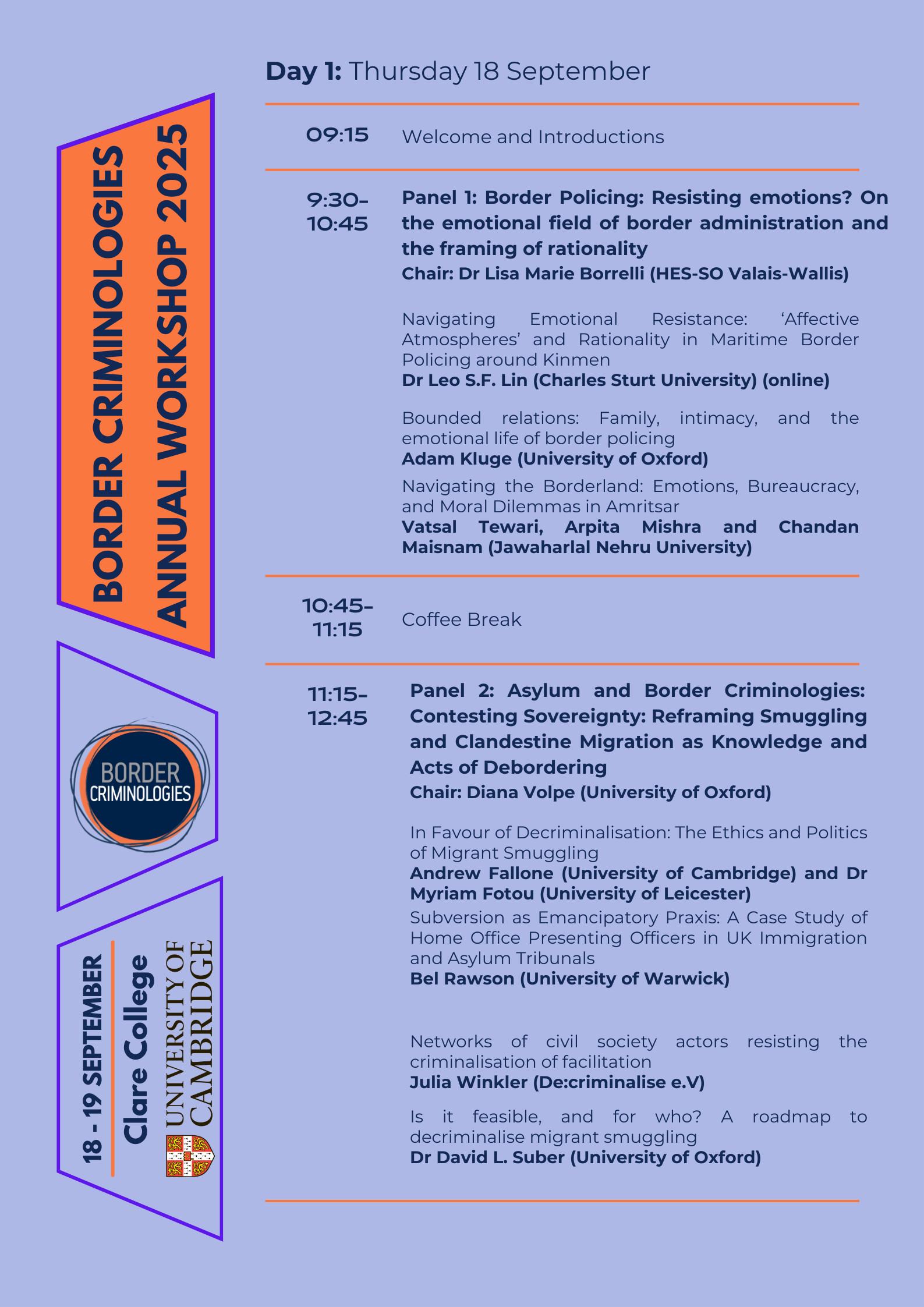
Thursday 18th September
9:15 Welcome and Introductions
9:30-10:45
Panel 1: Border Policing: Resisting emotions? On the emotional field of border administration and the framing of rationality
Chair: Dr Lisa Marie Borrelli (HES-SO Valais-Wallis)
Navigating Emotional Resistance: ‘Affective Atmospheres’ and Rationality in Maritime Border Policing around Kinmen
Dr Leo S.F. Lin (Charles Sturt University) (online)
Bounded relations: Family, intimacy, and the emotional life of border policing
Adam Kluge (University of Oxford)
Navigating the Borderland: Emotions, Bureaucracy, and Moral Dilemmas in Amritsar
Vatsal Tewari, Arpita Mishra and Chandan Maisnam (Jawaharlal Nehru University)
10:45 – 11:15 Coffee Break
11:15 – 12:45
Panel 2: Asylum and Border Criminologies: Contesting Sovereignty: Reframing Smuggling and Clandestine Migration as Knowledge and Acts of Debordering
Chair: Diana Volpe (University of Oxford)
In Favour of Decriminalisation: The Ethics and Politics of Migrant Smuggling
Andrew Fallone (University of Cambridge) and Dr Myriam Fotou (University of Leicester)
Subversion as Emancipatory Praxis: A Case Study of Home Office Presenting Officers in UK Immigration and Asylum Tribunals
Bel Rawson (University of Warwick)
Networks of civil society actors actively resisting the criminalisation of facilitation
Julia Winkler (De:criminalize e.V)
Is it feasible, and for who? A roadmap to decriminalise migrant smuggling
Dr David L. Suber (University of Oxford)
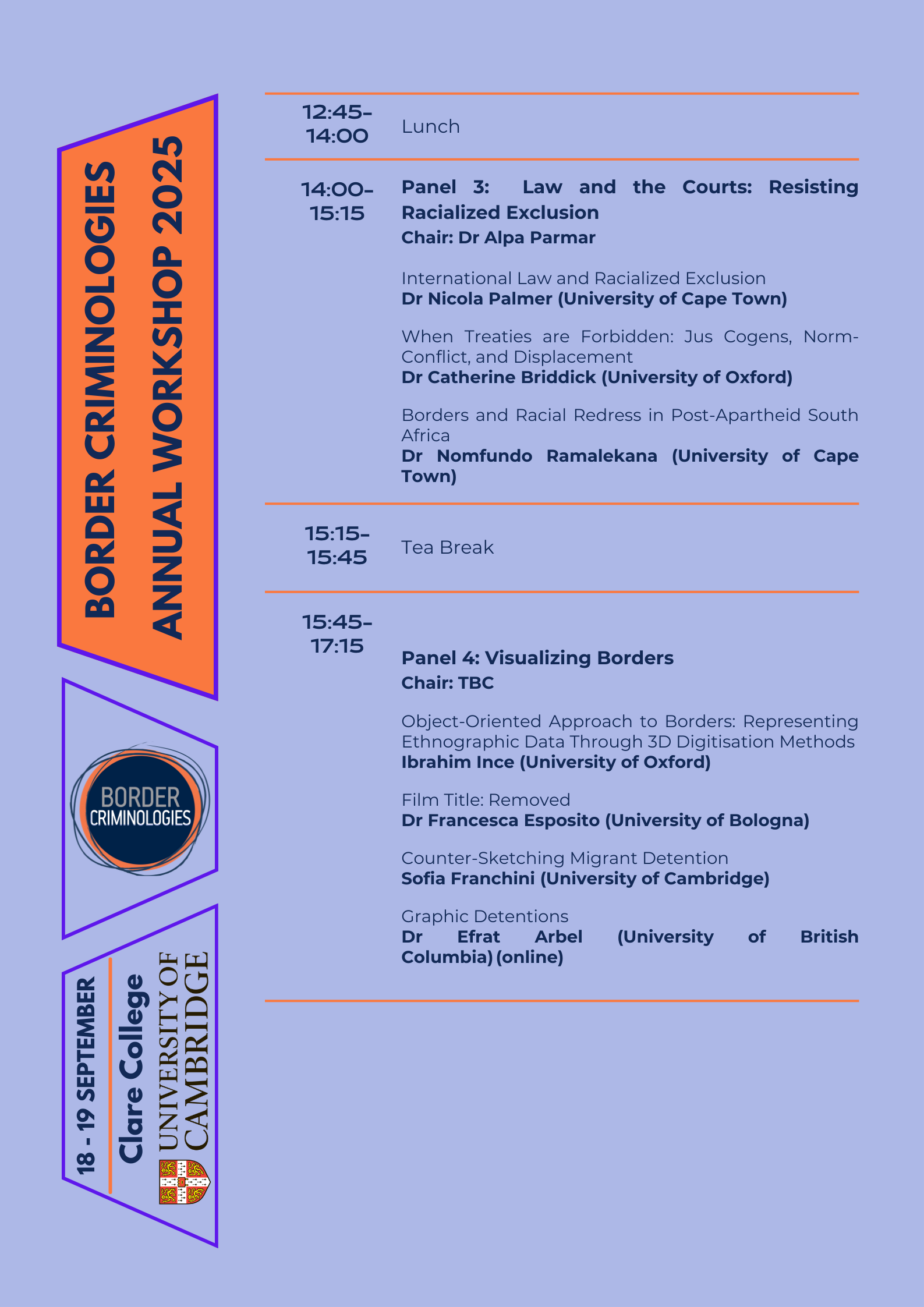
12:45-14:00 Lunch
14:00-15:15
Panel 3: Law and the Courts: Resisting Racialized Exclusion
Chair: Dr Alpa Parmar
International Law and Racialized Exclusion
Dr Nicola Palmer (University of Cape Town)
When Treaties are Forbidden: Jus Cogens, Norm-Conflict, and Displacement
Dr Catherine Briddick (University of Oxford)
Borders and Racial Redress in Post-Apartheid South Africa
Dr Nomfundo Ramalekana (University of Cape Town)
15.:5-15:45 Tea
15:45-17:15
Panel 4: Visualizing Borders
Chair: TBC
Object-Oriented Approach to Borders: Representing Ethnographic Data Through 3D Digitisation Methods
Ibrahim Ince (University of Oxford)
Film Title: Removed
Dr Francesca Esposito (University of Bologna)
Counter-Sketching Migrant Detention
Sofia Franchini (University of Cambridge)
Graphic Detentions
Dr Efrat Arbel (University of British Columbia) (online)
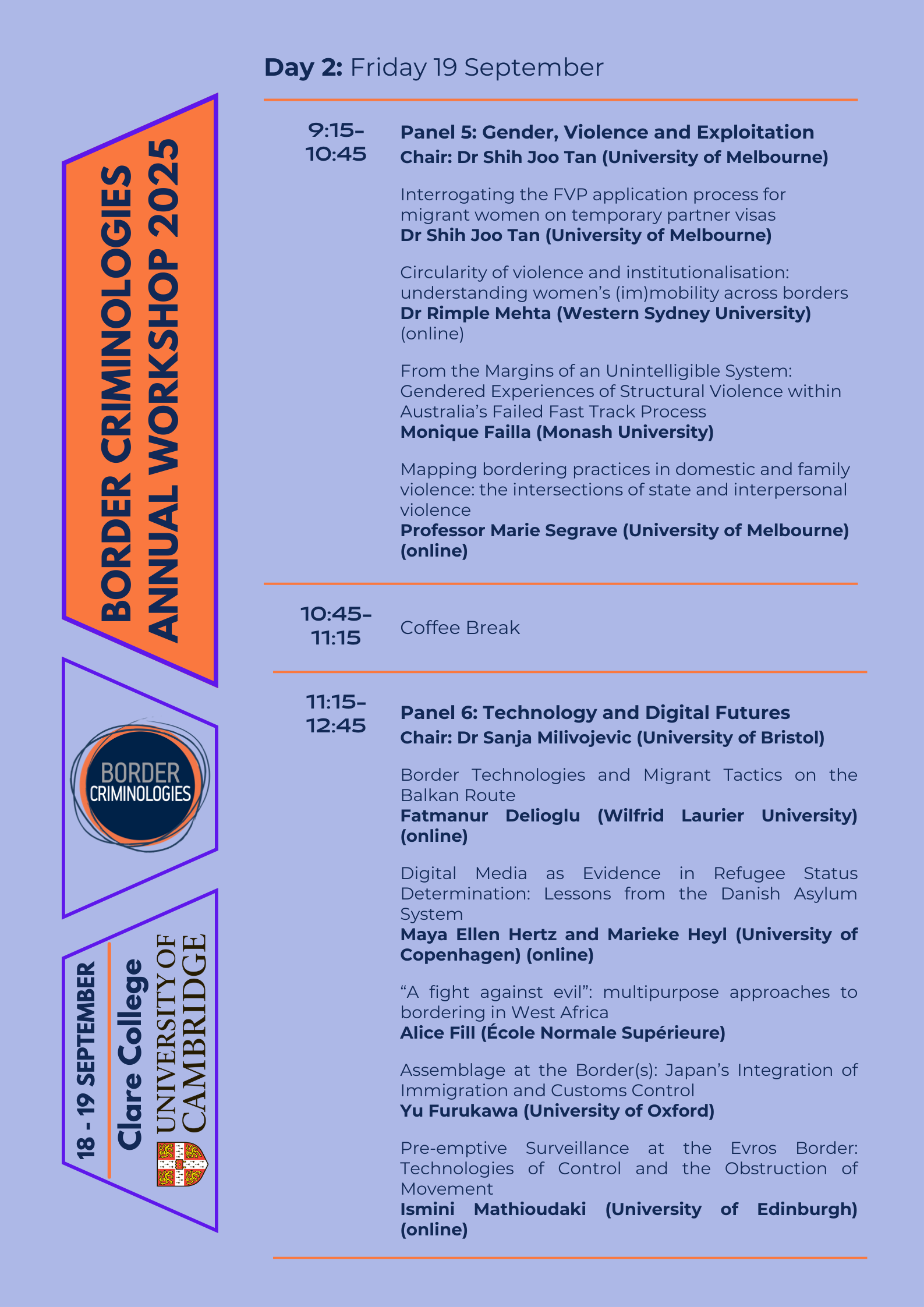
Friday 19th September
Panel 5: Gender, Violence and Exploitation
9:15-10:45
Chair: Dr Shih Joo Tan (University of Melbourne)
Interrogating the FVP application process for migrant women on temporary partner visas
Dr Shih Joo Tan (University of Melbourne)
Circularity of violence and institutionalisation: understanding women’s (im)mobility across borders
Dr Rimple Mehta (Western Sydney University) (online)
From the Margins of an Unintelligible System: Gendered Experiences of Structural Violence within Australia’s Failed Fast Track Process
Monique Failla (Monash University)
Mapping bordering practices in domestic and family violence: the intersections of state and interpersonal violence
Professor Marie Segrave (University of Melbourne) (online)
10:45 -11:15 Coffee Break
11:15- 12:45
Panel 6: Technology and Digital Futures
Chair: Dr Sanja Milivojevic (University of Bristol)
Border Technologies and Migrant Tactics on the Balkan Route
Fatmanur Delioglu (Wilfrid Laurier University) (online)
Digital Media as Evidence in Refugee Status Determination: Lessons from the Danish Asylum System
Maya Ellen Hertz and Marieke Heyl (University of Copenhagen) (online)
“A fight against evil”: multipurpose approaches to bordering in West Africa
Alice Fill (École Normale Supérieure)
Assemblage at the Border(s): Japan’s Integration of Immigration and Customs Control
Yu Furukawa (University of Oxford)
Pre-emptive Surveillance at the Evros Border: Technologies of Control and the Obstruction of Movement
Ismini Mathioudaki (University of Edinburgh) (online)
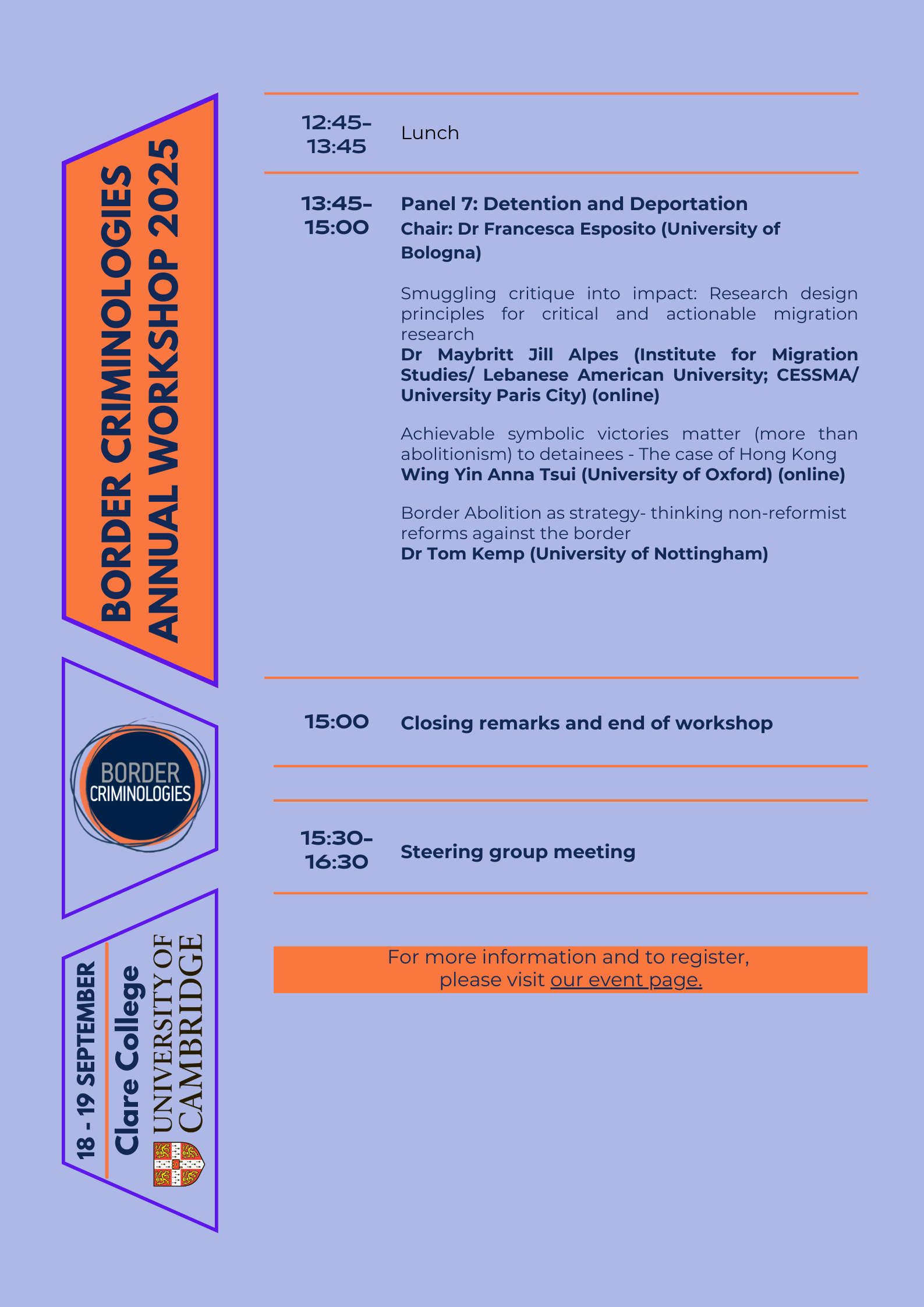
12:45-13:45 Lunch
13:45-15:00
Panel 7: Detention and Deportation
Chair: Dr Francesca Esposito (University of Bologna)
Smuggling critique into impact: Research design principles for critical and actionable migration research
Dr Maybritt Jill Alpes (Institute for Migration Studies/ Lebanese American University; CESSMA/ University Paris City) (online)
Achievable symbolic victories matter (more than abolitionism) to detainees - The case of Hong Kong
Wing Yin Anna Tsui (University of Oxford) (online)
Border Abolition as strategy- thinking non-reformist reforms against the border
Dr Tom Kemp (University of Nottingham)
15:00 Closing Remarks and End of Workshop
15:30-16:30 Steering Group Meeting
***********************
Workshop programme (pdf)
Theme:


