Symposium on 'Human Rights at Work: Reimagining Employment Law', by Alan Bogg, Hugh Collins, A.C.L. Davies, and Virginia Mantouvalou

Event date
5 November 2025
Event time
17:30 - 19:00
Oxford week
MT 4
Audience
Anyone
Venue
Bonavero Institute of Human Rights - Sir Joseph Hotung Auditorium

Notes & Changes

This event will be in-person and online. Please register via Zoom to attend online.

About the event

Employment today is marked by deepening tensions: between worker autonomy and employer control, between collective rights and individual freedoms, and between domestic law and international human rights standards. Human Rights at Work offers a bold and innovative framework for appraising employment law using a human-rights lens. The authors pose pressing questions: Should an employee be dismissed for personal political expression? Can workers wear religious dress at work? How should human rights apply across supply chains? And, crucially, is employment law in the United Kingdom compatible with international human-rights norms?

This symposium brings together scholars and practitioners to engage critically with the book’s arguments — examining how human rights constrain employer power, how they apply in the gig economy and across global supply chains, and what they mean for equality, dignity, and freedom at work. 

Join us for a lively discussion of a work that challenges us to rethink the future of rights in the workplace.

Authors

Photo of Hugh Colins. He is wearing a formal shirt and tie with a blazer.

Hugh Collins FBA is the Cassel Professor of Commercial Law at the London School of Economics and the Emeritus Vinerian Professor of English Law at All Souls College, Oxford. Previously, he was Professor of English Law at the London School of Economics and a Fellow of Brasenose College, Oxford. He studied law at Oxford and Harvard.  He served on the editorial committee of The Modern Law Review, including a period as General Editor, and is co-founder of the European Review of Contract Law. He has published research, including 20 books, in a wide range of fields, including contract law, employment law, European law, legal theory, and human rights law. Recent book publications include: Labour Law: Law in Context Series (Cambridge: Cambridge University Press, 3rd edn 2025) with K.D. Ewing and A. McColgan, Human Rights at Work (with A Bogg, ACL Davies, and V Mantouvalou) (Bloomsbury 2024).   

Headshot of Alan Bogg in a formal shirt, tie, and blue blazer.

Alan Bogg is Professor of Labour Law at the University of Bristol and a Barrister at Old Square Chambers, London. He is also a Deputy Chair of the Central Arbitration Committee. He was awarded the Peter Birks Prize for Outstanding Legal Scholarship in 2010 and the Philip Leverhulme Prize for Law in 2014. Prior to Bristol, he was Professor of Labour Law and a Fellow of Hertford College, Oxford, until 2017. He retains an Emeritus Fellowship at Hertford, and he is a Visiting Professor at the Faculty of Law, University of Oxford. 

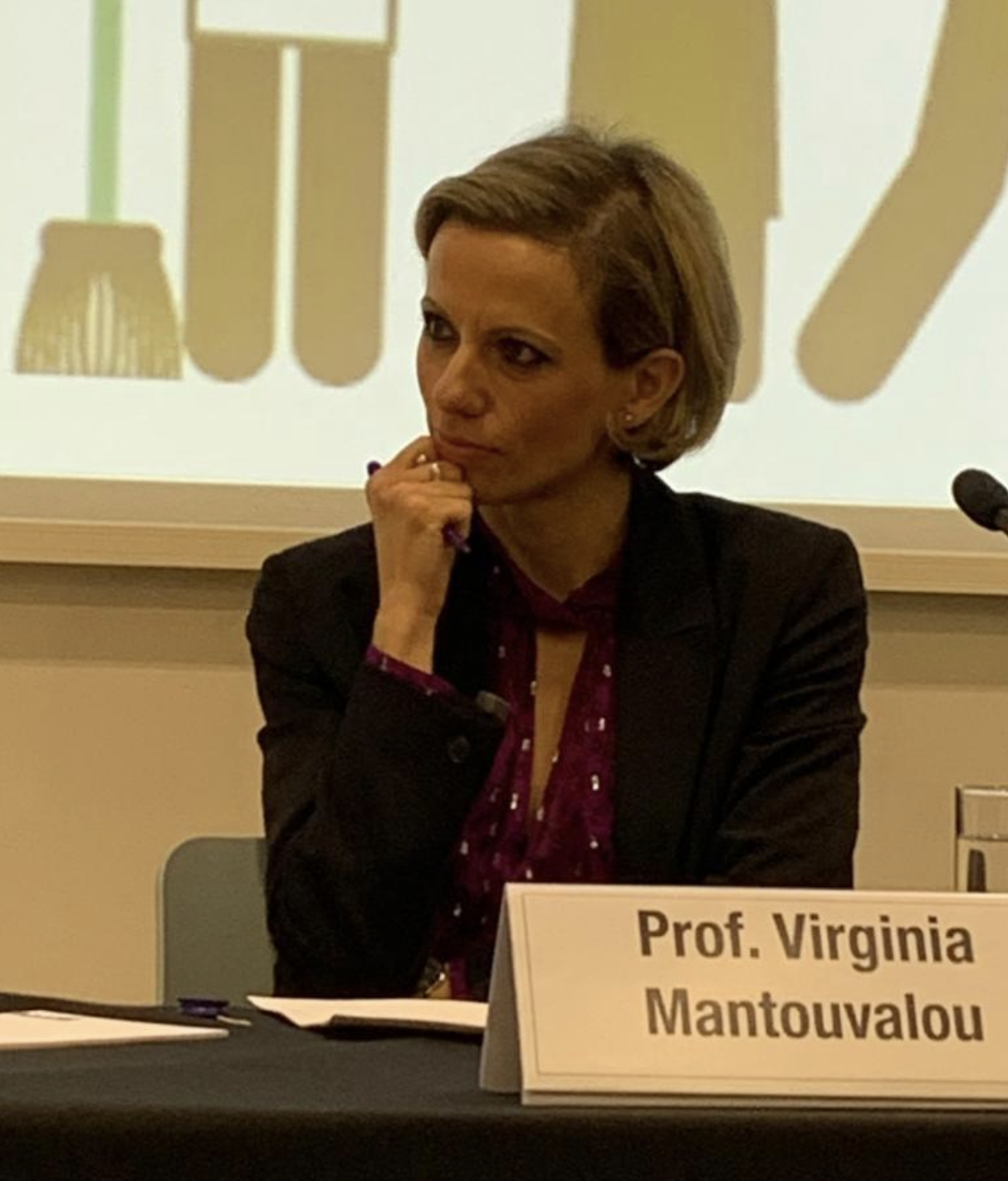
Candid of Virginia Mantouvalou at a conference.

Virginia Mantouvalou is Professor of Human Rights and Labour Law and Co-Director of the UCL Institute for Human Rights. Her recent publications include Structural Injustice and Workers’ Rights (OUP 2023), shortlisted for the 2025 Inner Temple Book Prize, Human Rights at Work (with A Bogg, H Collins and ACL Davies, Hart, 2024), Structural Injustice and the Law (co-edited with Jonathan Wolff; UCL Press 2024), and the European Labour Law Journal special issue (2024) on 'Work in Prison and Immigration Detention' (Guest Editor). Virginia is also Chair of the NGO Kalayaan, working on the rights of migrant domestic workers.

Headshot of Anne Davis in a black blouse and gold necklace

Professor Anne Davies FBA (publishing as ACL Davies) is Professor of Law and Public Policy in the Faculty of Law at the University of Oxford and a Fellow of Brasenose College. Her interests are in administrative law, with a particular focus on government contracts and contracted-out public service delivery, and in labour and employment law broadly defined. Her books include Accountability: A Public Law Analysis of Government by Contract (2001), The Public Law of Government Contracts (2008), Perspectives on Labour Law (2004, 2009), EU Labour Law (2012), Employment Law (2015), Valuing Employment Rights: A Study of Remedies in Employment Law (2024) and Human Rights at Work (with Alan Bogg, Hugh Collins and Virginia Mantouvalou) (2024). 

Discussants

Headshot of Claire Darwin KC in a white formal short and black blazer

Claire Darwin KC was called to the Bar of England & Wales in 2005 and appointed King’s Counsel in 2023. She read History at St Catharine’s College, Cambridge, and at Heidelberg University, Germany. 

A leading specialist in employment and discrimination law, Claire’s practice spans high‑value and complex litigation for both private‑ and public‑sector clients. Her recent instructions range from multi‑party equal‑pay and whistle‑blowing claims in the financial and technology sectors to major group litigation for universities; and include the recent “married banker” case for Merryl Lynch/Bank of America. She represented Samira Ahmed in her equal pay case against the BBC, Martine Croxall in her recent appeal to the Employment Appeal Tribunal, and has advised and represented many other senior female TV and radio presenters whose cases have settled. 

Claire was shortlisted by The Legal 500 as ‘2024 Employment Silk of the Year’, and as ‘2023 Public Services and Charities Silk of the Year’. She has been ranked in the top tiers of Chambers & Partners and The Legal 500 for Employment, Education, Pensions, and Administrative & Human Rights Law for many years. Claire has twice been appointed to the Attorney General’s A Panel of Counsel to the Crown (having previously served on the B and C Panels) and has also been appointed to the Attorney General’s Panel of Special Advocates and the Equality and Human Rights Commission’s Panel of Preferred Counsel, including the current 2024-2028 panel. 

Jeremias Adams-Prassl's research focuses on technology, innovation policy, and the future of work in the European Union and beyond. He is a Fellow of Magdalen College. Jeremias read law at Oxford (MA, MSt, DPhil), Paris (DSDFE), and Harvard Law School (LL.M.); he also holds a doctorate in law (honoris causa) from Lund University. Visiting positions include stints at Bocconi University Milan, the College of Europe, Hong Kong University, the European New School of Digital Studies, University College London, the University of Vienna, and Yale Law School.

Since April 2021, Jeremias has led a five-year, interdisciplinary project exploring the rise of Algorithms at Work, funded by the European Research Council and a 2020 Leverhulme Prize.

His book Humans as a Service (OUP 2018, Paperback 2019) explores the promise and perils of work in the gig economy across the world. It was awarded the 2019 St Petersburg Private Law Prize, and has been translated into multiple languages. Jeremias’ research on innovation policy and labour market regulation is frequently drawn on by governments and international organisations, including the European Commission, the International Labour Organisation, and the OECD, and has been cited by courts, policy documents, and news organisations in multiple jurisdictions. He has served on the World Economic Forum’s Global Future Council on the New Agenda for Work, Wages, and Job Creation.

Jeremias is the author of Great Debates in EU Law (with Prof Sanja Bogojević, 2021), and the founding editor of the EU Law in the Member States Series (Hart), exploring the impact of Union law across the Member States. His contributions to that series include The EU Charter of Fundamental Rights in the Member States (2020, with M Bobek), Air Passenger Rights, Ten Years On (2016, with M Bobek), and Viking, Laval and Beyond (2015, with M Freedland). He is currently writing an introduction to EU Labour and Internal Market Law for OUP's Clarendon Law Series.

Jeremias also writes on the law and economics of fragmenting labour markets and access to justice. His work has been recognised by a number of prizes for teaching, research, and public impact, including the Wedderburn Prize and the Apgar Prize, an Oxford University Teaching Award, a British Academy Rising Star Engagement Award,  an O2RB Excellence in Impact Award, and an ESRC Outstanding Impact in Public Policy Prize.

Other recent publications include The Concept of the Employer (OUP 2015; Paperback 2016), and The Autonomy of Labour Law (co-ed, Hart 2015). Jeremias is one of the editors of The Contract of Employment (OUP 2016), and an editor of Chitty on Contracts (33rd ed, Sweet & Maxwell 2018).

Image of tutor Marija Jovanivic

Marija Jovanovic is a human rights lawyer with a research interest in modern slavery and human trafficking, business and human rights, labour rights, migration and refugee law, and regional human rights regimes. She holds DPhilMPhil, and Magister Juris degrees from the University of Oxford, and a law degree from Serbia.

Marija is currently a Research Fellow in Business and Human Rights at the Bonavero Institute of Human Rights, and a Co-Investigator on behalf of the Bonavero Institute to the AHRC-funded Modern Slavery and Human Rights Policy and Evidence Centre. She also holds a Senior Lectureship at the Essex Law School. She previously held a Research Fellowship at the Centre for International Law, the National University of Singapore, and a Lectureship in Law in Serbia.

She is the author of State Responsibility for ‘Modern Slavery’ in Human Rights Law (Oxford University Press, 2023) and her recent work has focused on the compatibility of the UK’s immigration legislation with its human rights obligations towards victims of modern slavery, the experiences of modern slavery survivors in the UK prisons, and the issue of child criminal exploitation in the UK. Marija is currently working on the programme of research that focuses on labour exploitation including the ways in which states approach this issue both domestically and through supply chain regulation.  

Marija’s academic work seeks to contribute to both theory and practice of human rights law and is policy-oriented and impact-driven. Her legal consulting roles include collaborations with prominent international and civil society organisations in the human rights field.

Chair

Kate O'Regan

Kate O'Regan is the inaugural Director of the Bonavero Institute of Human Rights and a former judge of the South African Constitutional Court (1994 – 2009). In the mid-1980s she practiced as a lawyer in Johannesburg in a variety of fields, but especially labour law and land law, representing many of the emerging trade unions and their members, as well as communities threatened with eviction under apartheid land laws.  In 1990, she joined the Faculty of Law at the University of Cape Town, where she taught a range of courses including race, gender and the law, labour law, civil procedure, and evidence. Since her fifteen-year term at the South African Constitutional Court ended in 2009, she has amongst other things served as an ad hoc judge of the Supreme Court of Namibia (from 2010 - 2016), Chairperson of the Khayelitsha Commission of Inquiry into allegations of police inefficiency and a breakdown in trust between the police and the community of Khayelitsha (2012 – 2014), and as a member of the boards or advisory bodies of many NGOs working in the fields of democracy, the rule of law, human rights and equality.

Found within

Labour Law