
Oxford CSLS announces workshop on the future of fact-checking
Call for Participation and submission of papers
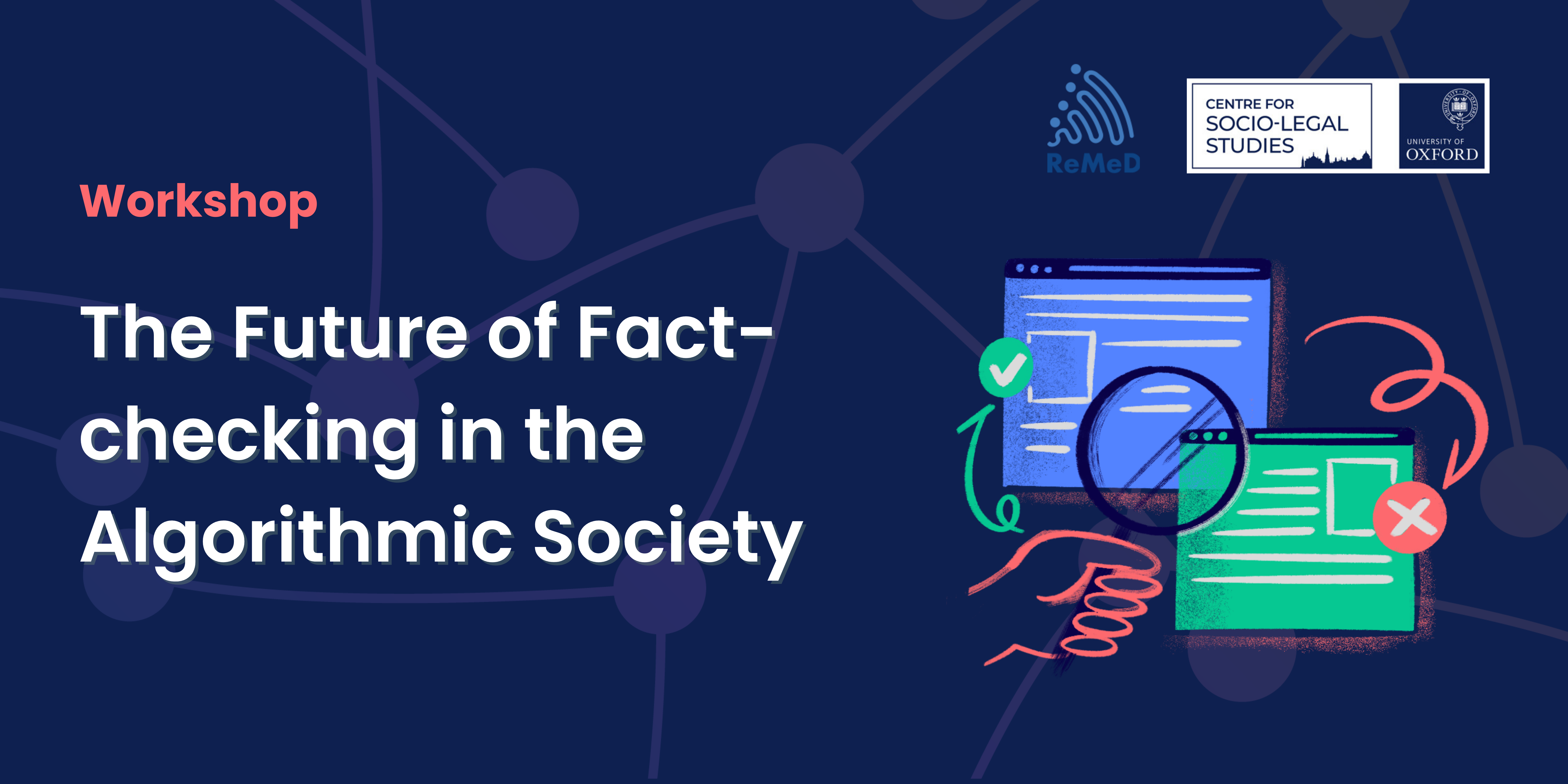
We are pleased to announce the Call for Abstracts for the upcoming Workshop ‘The Future of Fact-Checking in the Algorithmic Society’, which will be held on 27-28 November 2025 at Exeter College, Oxford.
Overview
In light of recent political developments—particularly in the United States, where major technology companies have significantly scaled back their support for fact-checking initiatives—the global fact-checking community is confronting growing uncertainty, compounded by rapid technological shifts such as the rise of generative AI, which complicates efforts to combat misinformation at scale.
Recognising the potential implications of these and similar future shifts, we are inviting fact checkers, civil society actors, academics and researchers working on fact-checking and media regulation to join us for an exciting two-day workshop organized by the EU Horizon Project ReMeD (Resilient Media for Democracy in the Digital Age) and the Centre for Socio-Legal Studies at the University of Oxford.
This workshop will provide a platform for dialogue, knowledge sharing, and collaboration among key stakeholders in the fact-checking ecosystem including academics, factcheckers, and media.
The event will focus on debating the current state and future of the fact-checking landscape and initiatives, including threats and challenges to fact-checking, including by AI; exploring the rapidly shifting governance and institutional frameworks for factcheckers; and looking ahead to new opportunities to fact-checking organisations, particularly at how AI tools can support fact-checkers.
Who Should Apply?
We welcome applications from a wide range of possible participants:
- Researchers and academics focused on fact-checking regulation, media governance, and related fields.
- Fact-checkers, representatives of fact-checking organisations, and journalists.
- Civil society, policy makers, and funders working in the fact-checking or media governance space.
This workshop seeks to facilitate discussions on the challenges, threats, and transnational routes for collaborations between fact-checkers, especially at uncertain and unprecedent times.
We welcome contributions from scholars, activists, researchers, and professionals from all sectors to explore future of fact-checking in the algorithmic society.
This is intended to be an in-person workshop but in exceptional circumstances, particularly with strong proposed contributions to the special issue, we will facilitate online participation.
We encourage papers that address a wide range of topics. Examples might include:
- Rules which govern fact-checking activities, including the impact of social media companies’ policies or the relationship between organisations and governments.
- Debates about funding of fact-checking activities, impacts of funding cuts and perspectives on the sustainability of the field.
- Relationship between factcheckers and media or journalists, and relationship with trusted flaggers.
- Factchecking in polarized politics including factchecking by government organizations
- The effects of public scepticism towards fact-checking on fact checking organisations.
- Effectiveness of the fact-checking ecosystem in combating misinformation and responses to the ‘non-effectiveness’ argument.
- New threats and opportunities advanced by AI.
- If you are unsure about whether your contribution falls into these categories, please do not hesitate to get in touch with Nathalia Gonzalez (nathalia.gonzalezgutierrez@mansfield.ox.ac.uk) with any queries.
Submissions might take the form of academic articles, but we will also consider shorter policy briefs or reflections of real-life cases encountered by fact-checkers in their daily activities (see more information below)
Application Requirements
Interested individuals should submit the following documents:
- A short bio (up to 300 words)
- A brief abstract (up to 500 words) for an academic article, a research note, or a commentary on issues relevant to the workshop. Participants should indicate, in their application, the type of paper they wish to submit. For more information on the differences between the types of papers, see section ‘Guidelines for Contributions’ below. If participants wish to be considered for the special issue, participants will be asked to share draft papers by November 10, 2025.
Please submit your application to attend by 10 September 2025 using the online form available here: https://form.jotform.com/251772214253048
We will notify successful applicants by 30 September 2025. The strongest contributions will be published in a special issue with the Harvard Kennedy School’s Misinformation Review.
There is no fee for this workshop, catering will be provided. We regret that we are unable to cover travel and accommodation, although we will provide a list of affordable accommodation options.
Questions
Please contact Nathalia Gonzalez (nathalia.gonzalezgutierrez@mansfield.ox.ac.uk) with any questions.
Guidelines for Contributions
The HKS Misinformation Review publishes three different types of contributions:
| Type of contribution | Information |
Research article 3,000 words (or possibly longer) |
|
Research notes 1,500 – 2,500 words |
|
Commentaries 1,500 – 2,000 words |
|
All submissions must comply with the formatting and contribution rules of the HKS Misinformation Review, accessible here.