

Report of the Oxford conference on “Assimilated law – the role and future of retained EU law in the UK”


“Get Brexit done” was the slogan with which Boris Johnson conducted his 2019 campaign for the premiership. Since then, much of the UK’s political debate has turned on what leaving the European Union was actually supposed to mean in legal, constitutional, and practical terms, given that the EU membership had shaped the legal systems of the UK for decades. Although the UK left the EU under Article 50(2) TEU when the Withdrawal Agreement entered into force on 1 February 2020, almost the entirety of EU law continued to apply during the transition period until 31 December 2020. Since 2021, under the Trade and Cooperation Agreement (TCA), EU law no longer affects UK law, and the UK is no longer bound by EU law or its further development.
Nevertheless, the UK decided unilaterally to retain much of EU law. This legal snapshot was created by the European Union (Withdrawal) Act 2018, as amended, and was initially described as “retained EU law”. The Retained EU Law (Revocation and Reform) Act 2023 did not produce the wholesale abolition once politically envisaged, but it modified the role and future of this body of law and renamed it “assimilated law”. That label is not unproblematic as it tends to obscure the EU law origin of the rules without itself achieving any substantive assimilation into domestic law.
Assimilated law therefore remains, by its nature, a derivative of EU law as well as a bridge to the EU legal order. Yet its character is conceptually difficult because EU law is continuing to develop dynamically, while the UK has lost its former influence in shaping the rules of the bloc. It also exposes the difficulty of separating EU instruments from EU constitutional values: interpreting retained EU rules without the requirements and objectives of EU principles, or without a clear domestic substitute for them, is extremely difficult and therefore uncertain. More broadly, assimilated law raises rule-of-law questions about the separation of powers, since the judiciary has been asked to fill gaps created by Brexit legislation, while the executive has taken far-reaching powers to amend or replace the retained law. The successful legal realisation of Brexit therefore appears to require action by all three branches of government, and continuing dialogue with the EU.
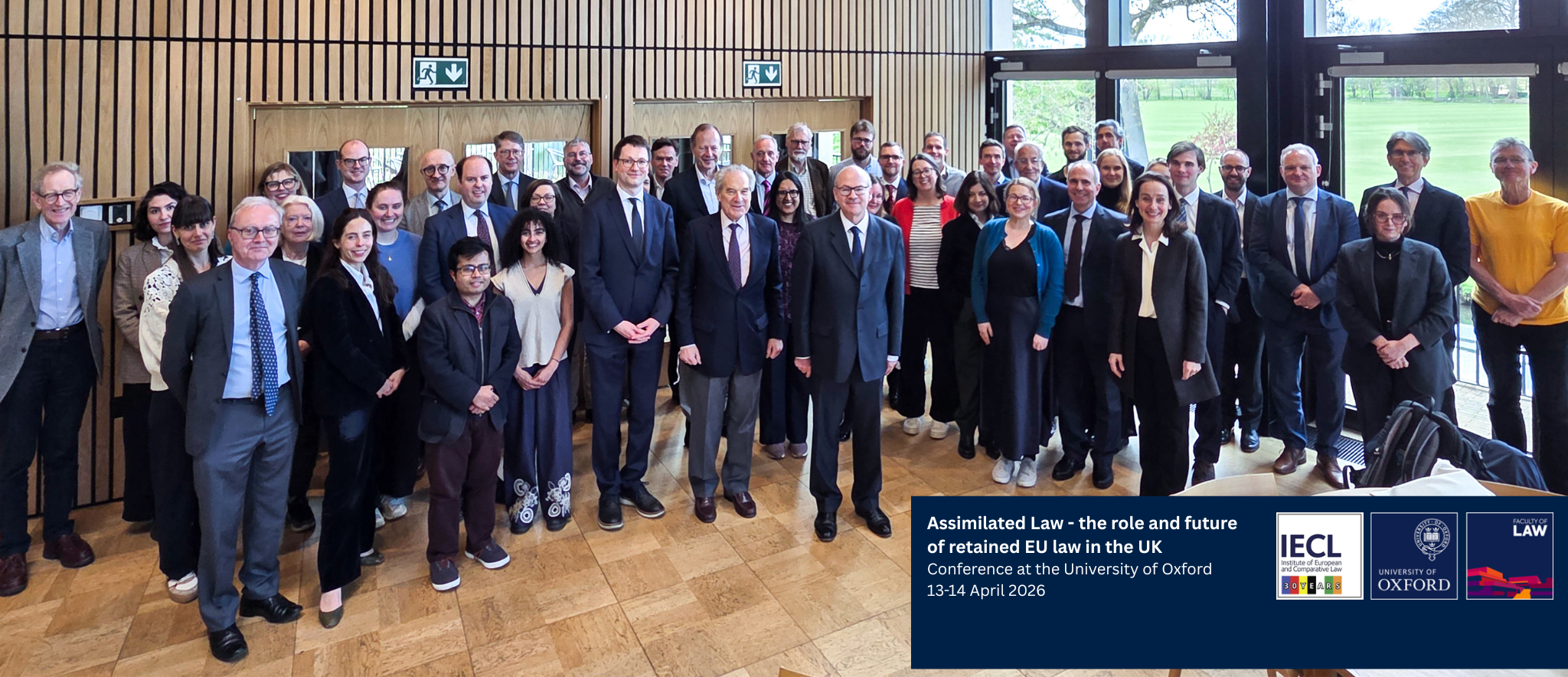
These issues formed the subject of a two-day conference at the University of Oxford entitled “Assimilated law: the role and future of retained EU law in the UK”. It was organised by Anne Davies and Johannes Ungerer and took place at St Hilda’s College, funded by the Institute of European and Comparative Law as part of its 30th anniversary events. Lord Mance, a former Deputy President of the UK Supreme Court and the chairman of the Institute’s Advisory Council, chaired most discussions. The conference brought together participants from academia and practice, including representatives from all branches of government, and examined the status of assimilated law, comparative and EU law perspectives, and developments of assimilated law in specific areas.

Lord Sales, the Deputy President of the UK Supreme Court, opened with a keynote lecture on the concept, status, and constitutional place of assimilated law. He stressed that the 2023 Act abolished general principles of EU law and the principle of primacy, but did so without substantially rewriting the retained provisions themselves. The result is domestic law whose interpretation still depends on its EU law origin. For Lord Sales, courts should first interpret assimilated law as domestic law, but then test that interpretation against legal certainty and the legislative desire for continuity. Particular care is needed where reasoning in judgments from the Court of Justice of the European Union (CJEU) reflects EU specific “meta-purposes”, such as the internal market, although access to that market may continue to be a UK interest. He also warned that executive powers to amend assimilated law by statutory instrument raise constitutional concerns.
Catherine Barnard (Cambridge) considered whether the move to assimilated law has made a difference, using the example of employment law. On the basis of Employment Tribunal decisions between April 2024 and April 2026 concerning part-time work, fixed-term work, and agency work, she found striking continuity. Tribunals generally continued to interpret the relevant rules as they had before Brexit, with one noticeable exception only; parties rarely relied on the changed status of the law. Overall, the retained framework has produced stability rather than rupture.
Dorota Leczykiewicz (Oxford) examined the changed authority of CJEU case law in UK judicial decision-making, drawing on Neil Duxbury’s account of legal authority. Her central point was that Brexit did not make CJEU case law irrelevant, but transformed the kind of authority it possesses. Pre-2021 CJEU decisions retain formal authority in the interpretation of assimilated law, subject to the qualified power of the higher courts to depart from them. At the same time, that authority is now conditional: UK courts must ask whether the principles underlying a CJEU decision still fit the post-Brexit domestic legal order. This leaves difficult questions, especially where Parliament has not replaced assimilated law: does legislative inaction signal acceptance of the underlying EU law principles, or merely leave the courts to decide how far those principles should continue to matter?
Emily Hancox (Bristol & Deighton Pierce Glynn) then addressed in greater detail when UK courts may depart from assimilated case law. Post-Brexit CJEU decisions are no longer binding, although UK courts may have regard to them; pre-Brexit CJEU and domestic case law may be departed from by the higher courts in line with ordinary domestic precedent rules, i.e. “when it appears right to do so.” Hancox showed that this standard has produced uneven reasoning, including differing views on whether legislative inaction supports continuity or departure. In practice, however, courts have rarely departed from CJEU case law, often invoking legal certainty, continuity, and the CJEU’s expertise. She predicted gradual change rather than the disappearance of CJEU influence.
Simon Whittaker (Oxford) considered UK legislation which replaces assimilated law. The 2023 Act empowers Ministers to restate, revoke or replace retained EU law, while Parliament has also enacted replacement regimes such as the Digital Markets, Consumer and Competition Act 2024. Replacement law raises rule-of-law concerns where executive law-making assumes a legislative character. It also raises interpretative questions: although replacement law is not assimilated law, it often retains EU-derived language and concepts. Whittaker argued that CJEU case law may remain useful where replacement law preserves EU structures.
Enriching the UK-internal debate, comparative papers showed what can be learnt from other Non-EU Member States in Europe with vast experience in aligning with EU law. Corinne Widmer-Lüchinger (Basel) presented the Swiss approach, marked by autonomous adoption of EU law and pragmatic methodological pluralism for interpreting it. Swiss courts may follow CJEU case law where alignment supports market access, but may also decline to follow it where the CJEU’s reasoning rests on EU-specific purposes with no Swiss equivalent. She suggested that identifying such purposes is crucial for the UK, although British courts face a different problem because EU law entered UK law while the UK was still a Member State.
Mads Andenæs (Oslo & Brick Court Chambers) contrasted the UK with Norway. Norway is not an EU Member State, but its position within the EEA and EFTA embeds EU internal-market law in a dense treaty and institutional framework. The EFTA Surveillance Authority and the EFTA Court promote uniformity and relieve pressure on national courts. The UK, by contrast, has the TCA but no comparable institutional structure. The result is a greater risk of legal uncertainty and a more politically ambivalent relationship with the European internal market.
Johannes Ungerer (Oxford) showed that assimilated law is not only a concern within the UK, but that it may also matter within the EU itself. Directly, it may be applied by Member State courts in cross-border disputes through private international law, particularly under the EU rules of the Rome I and Rome II Regulations, for example in consumer, air-travel or data-protection cases. Thus, Member State courts might find themselves in the unusual situation that they have to apply a derivative and differing version of EU law, potentially having to ignore recent amendments in actual EU law. He also discussed the limitations of such application, for instance due to the overriding mandatory character of EU instruments such as the GDPR. Indirectly, assimilated law may become a comparative “living laboratory” for EU law reform considerations, since future divergence from a shared starting point allows policymakers and scholars to observe the practical effects of different legal choices in real time.
The conference benefitted from a wide range of subject-specific papers: they largely confirmed the general picture of continuity, albeit with important qualifications. Niamh Dunne (LSE) showed that UK competition law remains closely aligned with EU competition law despite section 60A of the Competition Act 1998 allowing departure from CJEU case law. Authorities and courts continue to rely on CJEU decisions, often without sustained engagement with the new statutory freedom to diverge. Similarly, Simon Gleeson (Oxford & Clifford Chance) found a comparable pattern in financial services regulation. UK law has remained closer to EU law than many expected, partly because the UK had strongly influenced the EU regime before Brexit and partly because both sides may still hope for future mutual recognition. Divergence is most visible in relation to non-European third-country providers, where the UK has historically favoured broader market access.
Stefan Enchelmaier (Oxford) examined exhaustion of intellectual property rights. Before Brexit, the UK followed CJEU case law on exhaustion, developed to reconcile intellectual property protection with free movement of goods. He found no post-Brexit departure from that case law and predicted continued adherence, including due to practical considerations, such as the position Northern Ireland, making coherence especially valuable. Phillip Johnson (KCL) likewise argued that EU law remains practically important in intellectual property. UK courts have generally continued to rely on CJEU decisions before and after Brexit, with only limited exceptions. Johnson saw the greatest potential for divergence in copyright, where the wording of UK law differs more sharply from EU law.
Anne Davies (Oxford), addressing labour law, noticed some signs of divergence in the specific area of working-time law. Brexit opened space for a more domestic understanding of purposive interpretation, and UK courts might give greater weight to textual limits than the CJEU. Legislative reforms, including changes to working-time rules and domestic record-keeping obligations, created a complex mix of EU-derived and purely domestic norms. Davies suggested that this may push courts increasingly towards domestic interpretative standards.
Oliver Butler (Nottingham) found that data protection law has moved only marginally from its EU starting point. The UK retained the GDPR with limited amendments, and the EU’s adequacy decisions have preserved data flows but constrained divergence. Although the Data Use and Access Act 2025 made targeted changes, including replacing “essentially equivalent” with “not materially lower” for international transfers, UK courts have so far remained close to CJEU data protection case law. Butler nevertheless noted that future treatment of post-2020 CJEU concepts remains uncertain.
Angus Johnston (Oxford) and John Bell (Queen Mary) considered energy law. The TCA provides the present basis for UK-EU cooperation in this area, but the energy chapter is limited in time and substance. In light of the war in Ukraine, energy insecurity, and the current UK political climate, energy cooperation may deepen, including through emissions trading and possible UK participation in the EU electricity market. Such steps could require alignment with EU law, state aid control, and CJEU-linked dispute settlement, raising renewed sovereignty questions.
Paul Beaumont (Stirling) addressed the UK rules on private international law and international civil procedure. The Regulations Rome I and Rome II have been retained, while Brussels Ia no longer governs new proceedings, leaving the Civil Jurisdiction and Judgments Act 1982 and doctrines such as forum non conveniens with greater importance. He advocated pragmatic, issue-specific reform rather than a pro- or anti-EU stance. Beaumont saw opportunities for targeted reform, while also stressing that most EU-derived rules work well and should simply be retained. The overall picture was therefore not one of dramatic rupture, but of cautious continuity and selective divergence.
It is envisaged that the conference proceedings will be published in a collective volume in due course.
Elisabeth Müller and Johannes Ungerer