

Contested access: methods, scrutiny, and solidarity at the border [Annual Workshop 2027]
Series:
Associated with:
 Add to calendar
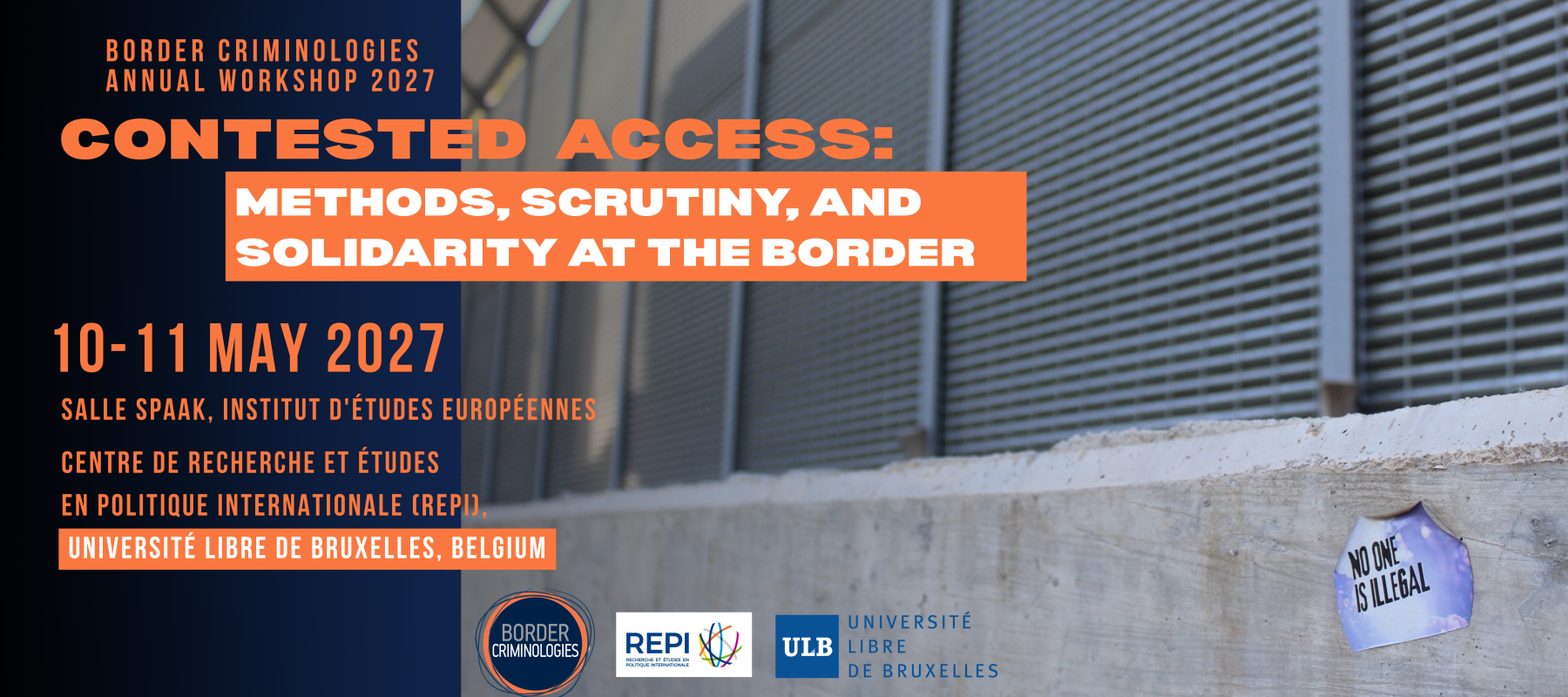
We are delighted to announce this year’s Annual Workshop on Contested access: methods, scrutiny, and solidarity at the border. This workshop will be hosted by Dr Diana Volpe at the Centre de Recherche et études en politique internationale (REPI) of ULB, Université Libre de Bruxelles, on 10-11 May 2027.
This year’s workshop will be focusing on creative research methodologies, access strategies, and solidarity in an era of unprecedented narrowing of possibilities. While human rights safeguards continue being eroded, this workshop offers a space to share and discuss together how to break through the walls of silence in spaces of exclusion and control, right at the time where scrutiny is most needed. At a time where research on border control continues to lose authority in policymaking spaces, we ask: what role does critical border scholarship play in affecting the realms of possibilities? As detention and deportation regimes become further externalised into third countries, how can research be mobilised in spaces where action is most necessary? What strategies can be employed to best gain access in spaces states deny scrutiny in? How can these be used to resist the tightening realm of chances to act in solidarity?
With this workshop, we aim to share and explore together different strategies for access and new research methodologies. Papers may include, for example:
- Creative, experimental, and/or participatory methodological approaches to study changing landscapes to asylum, borders, detention, and other spaces of exclusion;
- Negotiating, contesting, or circumventing institutional barriers to research access, including physical spaces like border zones, offshore or externalised sites;
- Navigating institutional obstacles to knowledge that is deliberatively rendered inaccessible, invisible, or difficult to scrutinise (for example, through the use of FOIs)
- Working with refusal: what should researchers do when access is denied, participants cannot safely speak, or conventional methods become impossible?
- Research encounters with border police, detention staff, bureaucrats, humanitarian actors, and others involved in the everyday menial implementation of border control;
- Methodological approaches to gendered and racialised violence, exploitation, and vulnerability across border regimes;
- The ethics and politics of research in hostile environments: positionality, researcher safety, surveillance, institutional risk, and protecting participants;
- The limits of visibility and transparency: when might making border practices visible reproduce harm, surveillance, or extractive relationships?
- Research after access: questions of responsibility, reciprocity, accountability, and what researchers owe to the people and communities who make research possible.
By foregrounding questions of methodologies and responsibility, we understand access broadly: not simply as physical entry into closed spaces, but as a question of whose knowledge becomes available, whose testimony is considered authoritative, and what ethical and political responsibilities accompany the production of knowledge about borders.
Participation
To participate, please submit a document including a short abstract (300 words), a bio, and indicating which thematic group the paper would best fit within. The document can be sent to bordercrim@law.ox.ac.uk using the subject “Annual Workshop 2027”. The extended deadline is November 14th, 2026.
Registration for the workshop will open once papers are selected. A participation fee of 5 euros will be required this year and will be dedicated to a creative session as part of the workshop program.
Timeline
Call opens: 1st October, 2026.
Submission deadline (Extended): 14th November, 2026.
Notification of selection: Early December


