

Faculty of Law and DPIR launch new MSc in Law, Governance and AI

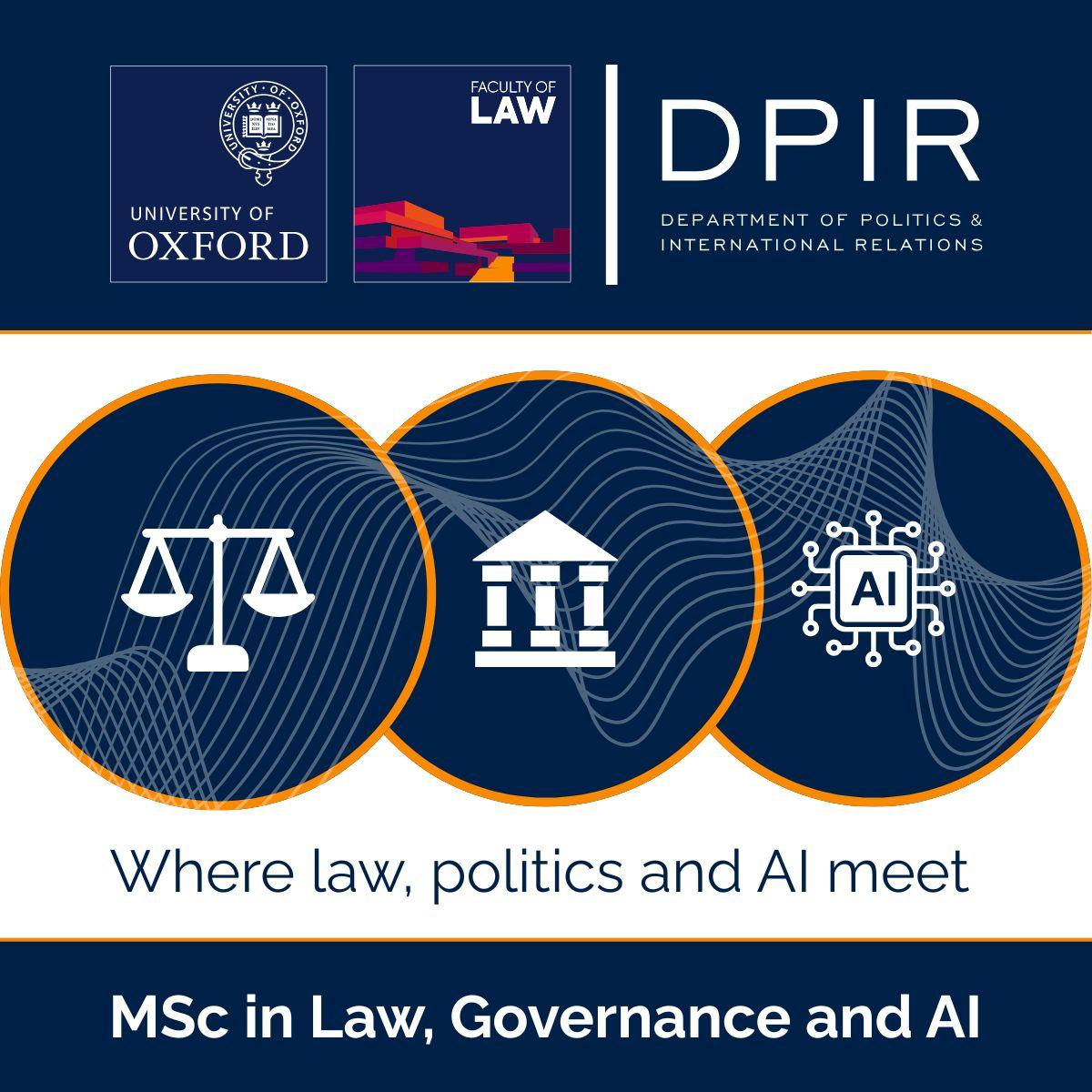
Oxford’s Faculty of Law and Department of Politics and International Relations (DPIR) today announce a new MSc in Law, Governance and AI. Designed to equip future leaders with the skills to govern AI responsibly, this 12-month course will be full-time and in-person, with first entry expected in the 2027–28 academic year. Applications will open soon.
The new, interdisciplinary programme is aimed at graduates and professionals from a range of backgrounds who want to understand how AI systems are reshaping law, public institutions, regulation and decision-making, and how responsible approaches to their design and use can be developed. While the growth of AI creates major opportunities, it also raises difficult questions about accountability, fairness, public value, legal responsibility and democratic oversight.
Co-directed by Ben Ansell, Professor of Comparative Democratic Institutions (DPIR), and Rebecca Williams, Professor of Public Law and Criminal Law (Faculty of Law), the MSc in Law, Governance and AI combines rigorous study of law, governance, politics and regulation with practical computational learning. Students will develop a shared vocabulary across disciplines, engage critically with the ethical and institutional implications of AI, and apply their learning through a practical group ‘Capstone Project’ focused on a real-world legal, governance or social challenge.
Professor Rebecca Williams’ work focuses on the relationship between law and technology, including the use of algorithms in decision-making. She says: “The governance of AI cannot be understood through law, technology or politics alone. It requires people who can move between disciplines, ask the right questions about accountability and public value, and work collaboratively on practical problems. This MSc in Law, Governance and AI brings those elements together, giving students the opportunity to understand how AI systems operate, how they are regulated, and how law and governance can respond to technological change.”
Professor Ben Ansell, a leading political scientist whose research spans topics including education, housing, inequality and democracy, adds: “AI raises fundamental questions about how societies make decisions, how institutions respond to change, and how democratic systems can remain accountable in the face of new technological power. This programme gives students the tools to think seriously about those questions, combining law, politics, governance and technical understanding so they can contribute to the responsible development of AI in public life.”
Find out more
Visit the MSc in Law, Governance and AI webpage to find out more and sign up to receive course updates, admissions information, invitations to future events and notification when applications open.