
Martje Köppen wins European Association of Climate Law’s Early Career Researcher Award

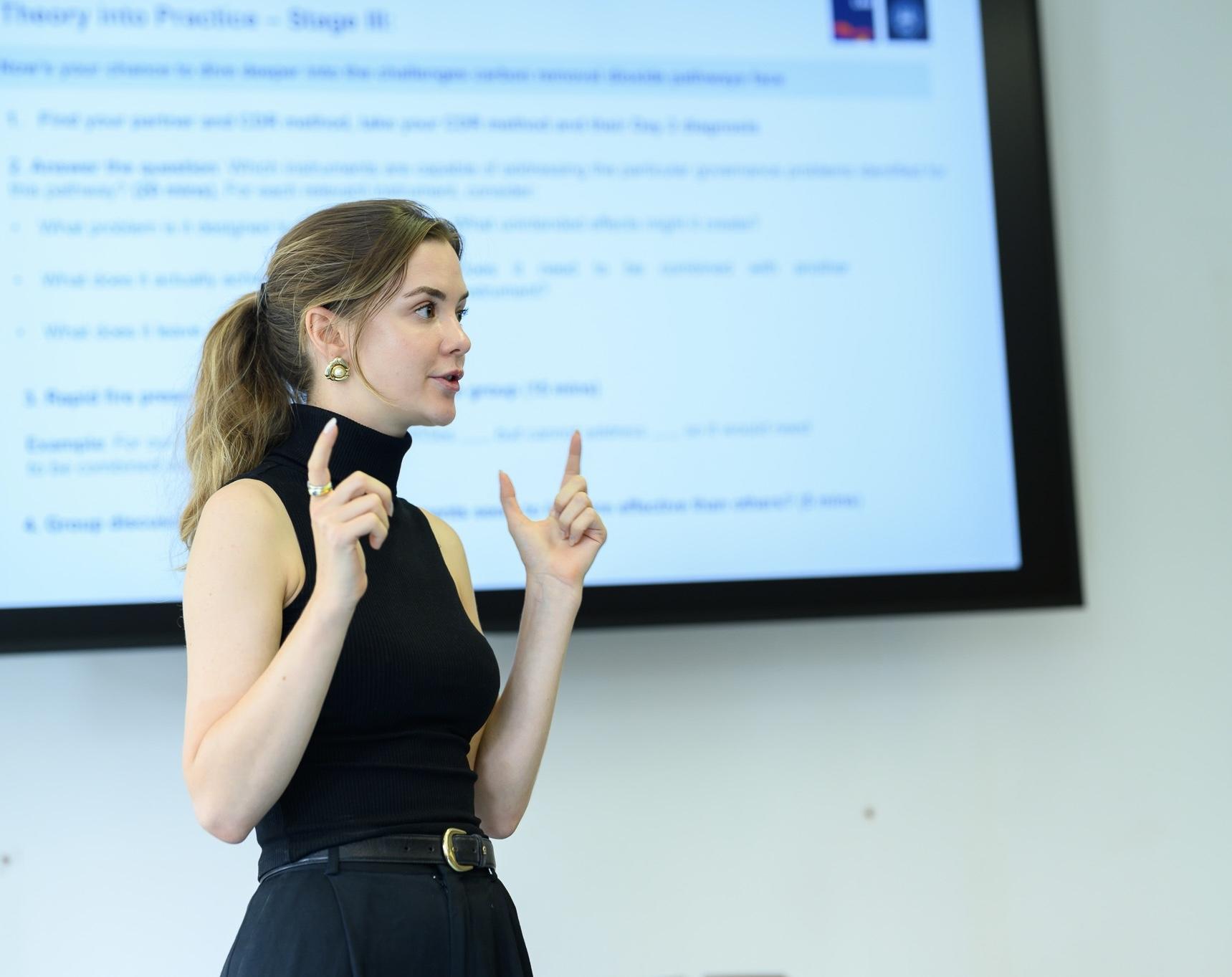
DPhil candidate Martje Köppen has won the European Association of Climate Law’s inaugural Early Career Researcher Award, which recognises outstanding research by early-career scholars that makes an original and significant contribution to the field of European climate law.
Martje, who is one of the Faculty of Law’s Dean’s Scholars, was recognised for her paper on the treatment of carbon dioxide removal (CDR) in European climate law. The judging panel highlighted the paper’s originality and detailed analysis of the ambiguous treatment of CDR in European climate law, and its contribution to understanding the implications of this ambiguity for the effectiveness of the EU climate framework.
We spoke to Martje about her research and her experience of studying at Oxford Law.
Tell us about your award-winning paper: what were your aims and findings?
My paper is titled ‘Slipping through the “Net” in Net Zero? The Ambiguous Role of Carbon Dioxide Removal in the European Climate Law’. It is a chapter of my DPhil thesis. My aim with this paper was to analyse how the introduction of removals into the existing EU climate law changes the overall functions of this body of law. I show that this ultimately reduces the effectiveness of the EU climate framework not just for the deployment of removals but also for the stringency of emission reduction obligations for Member States.
Broadly speaking, in my thesis I analyse the duality of transformations in and through climate law. By that I mean that I am investigating, for one, what role law plays in the transition to climate neutrality or, as it is more commonly referred to, net-zero. By targeting net-zero greenhouse gas emissions by 2050, the EU is legally obligated to reach a state in which any remaining emissions are balanced by removals of greenhouse gases from the atmosphere. Removals such as CDR are therefore the ‘net’ in ‘net zero’, so to speak. To meet the required removal levels, the EU would need to scale their deployment by an order of magnitude and there is an increasing amount of literature addressing how legislation and policy can facilitate such deployment of technologies.
Next to such questions of how transformations may be brought about through law, I also analyse how climate change and, specifically, removals transform the existing law. This second aspect is what this chapter is about. It highlights how the introduction of CDR into EU climate law changes some of the core functions of the targets and procedural obligations under EU climate law and ultimately reduces its effectiveness.
How did you feel when you found out you had won the award?
It really moved me! Winning this award from the EACL means a great deal to me because I am deeply passionate about the rigour of academic work. Research really is a craft. At the same time, I care deeply about the substance of my work: the climate and energy transition. It is not an abstract topic to me – it is one of the defining and legally disruptive challenges of our time. I spend significant time and effort thinking and writing about it, so it is wonderful to know that the results are valued by the wider climate law community. At a moment when the world is overshooting 1.5°C of global warming, this recognition is both humbling and motivating. It gives me renewed energy for the final stages of my DPhil and for passing on what I learn to students.
Tell us about your experience of undertaking a DPhil at Oxford Law.
Doing research in 2026 takes place in a time when public distinctions between fact and opinion are increasingly blurred, and restrictive closed-mindedness and ignorance shape public debates. This is amplified by the multiple ways in which knowledge production is being rapidly reshaped by artificial intelligence. In this context, I believe that it is both urgent and important to remember that open-mindedness, critical thinking and rigour are skills and habits that people can learn and that we can choose to practise. Often, we might think of them as innate: a person is either open-minded or they are not, and so on. But in fact, and as I have learned through my DPhil, they are skills. This gives us the chance, agency and responsibility to learn and practise them. Just as with any other skill, such as riding a bicycle, developing those skills requires a good understanding of the foundations of your skill, time for patient teaching and practice, critical evaluation and deliberation about mistakes, and communities that care enough to help you learn from your mistakes. As I start my last DPhil year, I am therefore especially grateful that Oxford has provided all of that for me and that the Faculty of Law has given me an intellectual home and a scholarly community.
Importantly, my supervisors, Professors Sanja Bogojević and Thom Wetzer, have taught me so much about how to do research. They challenge and develop my thinking and writing with me in ways that regularly push me beyond what I was able to imagine before. They encourage me to stay curious, to listen more carefully, and to see the world differently. I am deeply grateful to be afforded such care and support by my supervisors. I believe this is one of the most precious things we can afford other people: to genuinely care and support them. It has truly transformed and expanded my ways of thinking and knowing.
Both developing new skills and intellectual growth do, at times, come with growing pains – something many Oxford students and alumni may recognise – but my colleagues and friends have brought warmth and a great deal of joy into this DPhil journey. I have made some of the most meaningful friendships of my life in Oxford and seeing the new freshers arrive, I am so excited to see them form their own friendships now.
Crucially, the Faculty, and especially the Dean’s Scholars Fund, have enabled and supported my research from the first day. I am deeply grateful for this support. It has allowed me to work on the topic I care about most: climate and energy law. And there is a lot of rigorous work to be done in this field.
How is your DPhil progressing, and what are your plans for the future?
The DPhil is progressing well; it’s all coming together at the moment, and I am loving the research process!
As to the future: after the DPhil, I want to go sailing and bike-packing for a while. And then I like to think of my career in sequences. In the medium to long-term, I see myself working on developing legislation again, be it for the German government or the EU. I believe the future orientation and abstract general nature of legislation is uniquely well positioned to address some of the more pervasive features of climate change as an all-of-economy challenge and collective action issue. But as a next step after the DPhil, I want to work on the innovation and deployment of energy and climate technologies in a more hands-on way, either through more applied research or by building a startup in the energy technology realm.