UNESCO-Oxford Multilingual Massive Open Online Course (MOOC) on Freedom of Expression for Judicial Actors 2026
COURSE INTRODUCTION
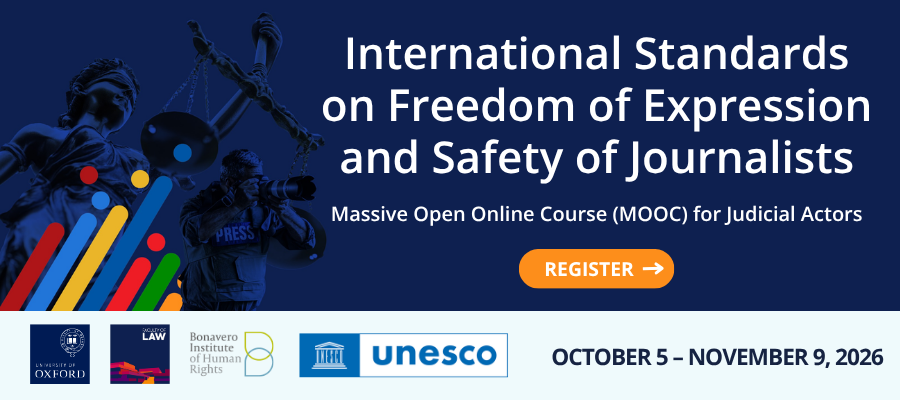
The Bonavero Institute of Human Rights and the United Nations Educational, Scientific and Cultural Organization (UNESCO) are delighted to announce the 2026 edition of their joint global Massive Open Online Course (MOOC) on the regional and international standards relating to freedom of expression, including press freedom, access to public information, safety of journalists and challenges created by the digital world. The MOOC will run between 5 October and 9 November 2026 and will comprise a series of weekly online modules.
It will be delivered in the six official languages of the United Nations (UN), i.e. in Arabic, Chinese, English, French, Russian and Spanish, as well as in Portuguese, and it will be free and open to judicial actors (e.g. judicial branches, public ministries, public defenders, electoral courts, human rights ombudsmen, judicial law clerks) from all justice systems, as well as to journalists, academics and other professionals across the world.
The course will draw on the UNESCO Toolkit for judges and judicial actors on freedom of expression standards and other materials, and it will build on the successful Oxford-UNESCO multilingual MOOC on Freedom of Expression and Safety of Journalists 2023, as well as the Oxford-UNESCO MOOC on Freedom of Expression delivered in English in 2021, and similar regional MOOCs previously organised by UNESCO focusing on Latin America and Africa.
The MOOC will cover (1) the general principles and scope of freedom of expression; (2) the limitations of the right; (3) the legal protection of the right to access to information; (4) the safety of journalists and the issue of impunity, and; (5) the contemporary digital challenges to freedom of expression and information, including those that arise through state and private regulation online. Please find below an overview of the MOOC modules.
The course is now open – please click here to register. You can also register directly for the language that you want to take the course in via the link to the EdX page on the right side of this page.
OVERVIEW OF THE COURSE
The five weekly modules of the MOOC are convened by academics and supplemented by the insights and experiences of prominent guest speakers. Every module introduces and discusses a pertinent topic with respect to the international and regional protection of freedom of expression. Each features accessible background material, comprehension quizzes, and a forum for further discussion on our EdX platform, as well as a pre-recorded webinar.
Duration: The course was launched on 5 October 2026 and will be delivered over a period of five weeks until 9 November 2026. One weekly module will be released on EdX starting 5 October 2026, and participants will have the flexibility to complete the course anytime before 7 December 2026. We estimate the time commitment to complete the course at under 2 hours per week, so it is suitable for anyone in full-time employment.
Languages of instruction: The course will be offered in seven languages, namely Arabic, Chinese, English, French, Portuguese, Russian and Spanish.
Registration: The course is now open – please click here to register. The MOOC is offered in seven different languages. Please make sure that you register for the language that you want to take the course in by selecting your language at the top right corner of the form. Please do not register in more than one language.
Credential: Participants who will successfully complete the course in any of the seven language versions will receive a certificate of completion in the language of the MOOC for which they enrolled (or in English). Please note that certificates may take up to three months to be processed and distributed.
Description of the MOOC modules & Schedule
Module 1: General principles and Scope of Freedom of Expression (Release: 5 October 2026)
Module 1 sets out the international legal framework underpinning the right to freedom of expression, notably under the International Covenant on Civil and Political Rights (ICCPR), and provides an overview of the general scope of the right in the doctrine of important regional protection regimes.
Module 2: Limitations (Release: 12 October 2026)
Module 2 explores the legitimate restrictions on the right to freedom of expression, as provided for in international and regional protection regimes, as well as the doctrine of courts.
Module 3: Access to information (Release: 19 October 2026)
Module 3 sets out the legal frameworks regarding the right to access to information, with a particular emphasis on the important role that it plays in ensuring democratic political processes and sustainable development.
Module 4: Safety of Journalists (Release: 26 October 2026)
Module 4 examines the safety of journalists and the issue of impunity, highlighting the physical risks that many journalists face, including the specific threats faced by women journalists.
Module 5: Digitalisation (Release: 2 November 2026)
Module 5 explores contemporary challenges to freedom of expression that have arisen particularly through the exercise of the right online, and how existing legal frameworks can be applied online.
Speakers: Guest speakers include judges and members of regional and international human rights courts, senior legal practitioners, academics specialising in freedom of expression, and representatives of relevant international organisations.
Questions? If you need further information about the course, please email bonavero.unesco.mooc@law.ox.ac.uk.
PROJECT PARTNERS